Stretch Ceiling Installation in Dubai

  • Turnkey Interiors Since 1996
  • DM Approved · DEWA Certified
  • Surveyed, Welded & Tensioned by Our Own Crew
  • Fire-Certified Membranes

Backlit and translucent luminous panels, printed sky ceilings, gloss, satin, matt and acoustic membranes — surveyed to the millimetre, manufactured off site and tensioned into place in days. No jointing, no sanding, no paint, and a ceiling that clips out again when the void needs opening.

Backlit, Translucent, Printed, Gloss, Satin & Acoustic MembranesInstalled in Days With No Wet Trades and Almost No DustSprinklers, Detectors, Diffusers & Speakers Coordinated Into the MembraneDemountable for Access — Clipped Out and Back InFire Classification Certificates Issued With Handover

Featured Stretch Ceiling Projects in Dubai

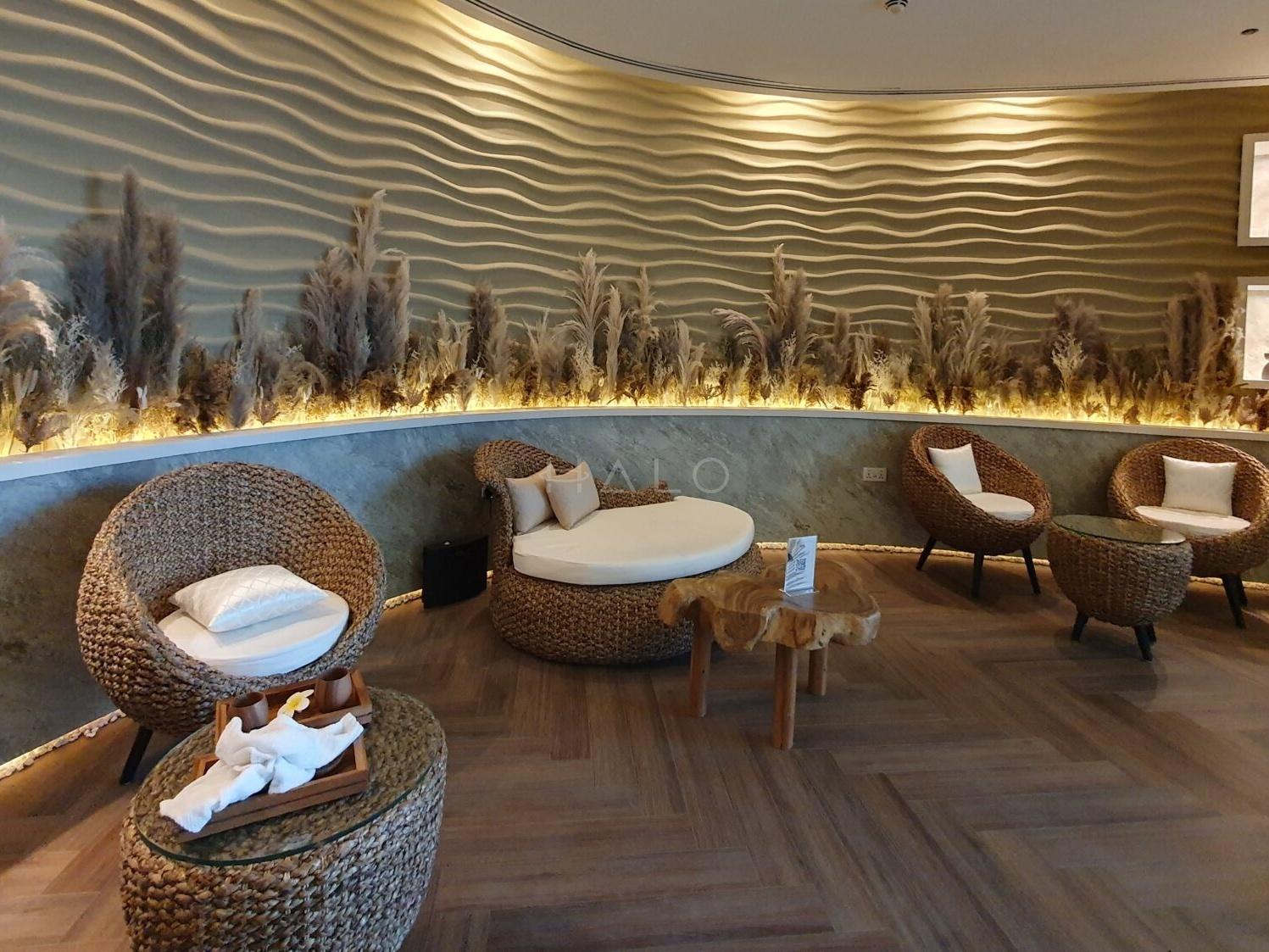
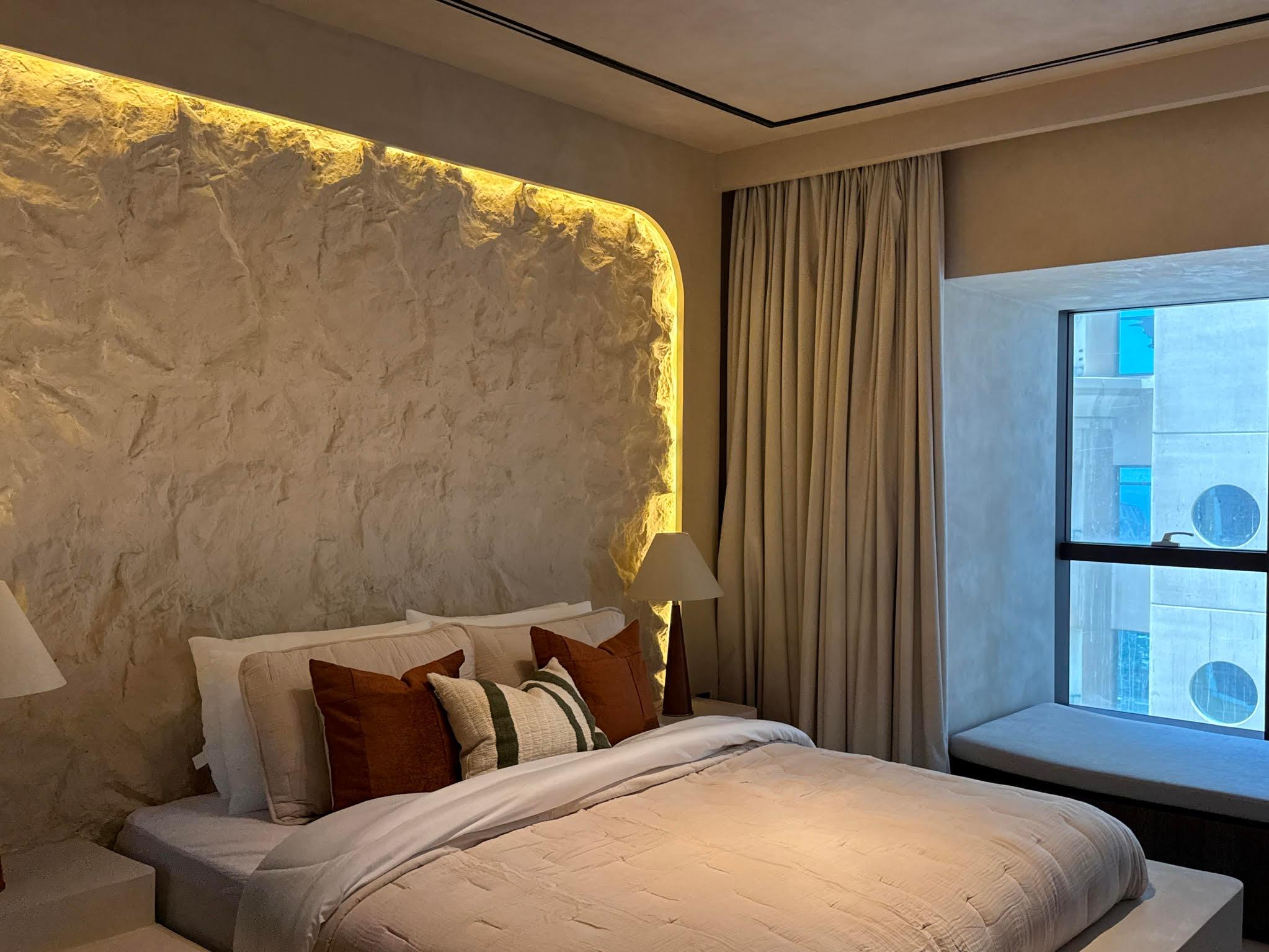
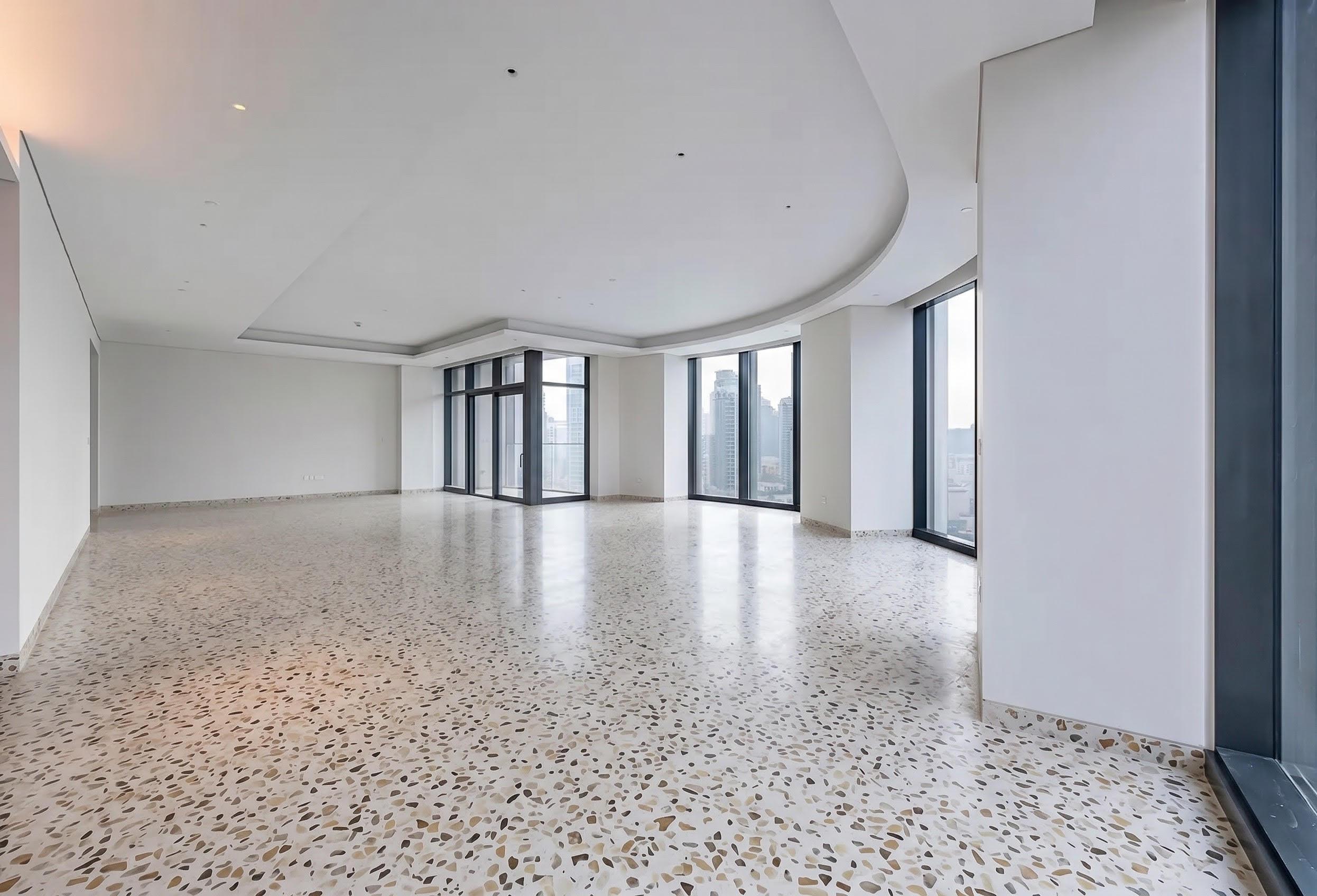
The portfolio above shows completed Halo ceiling work. Client names, unit areas and building details are not published without written permission, so the notes below describe the problem each ceiling was installed to solve rather than inventing addresses.

01

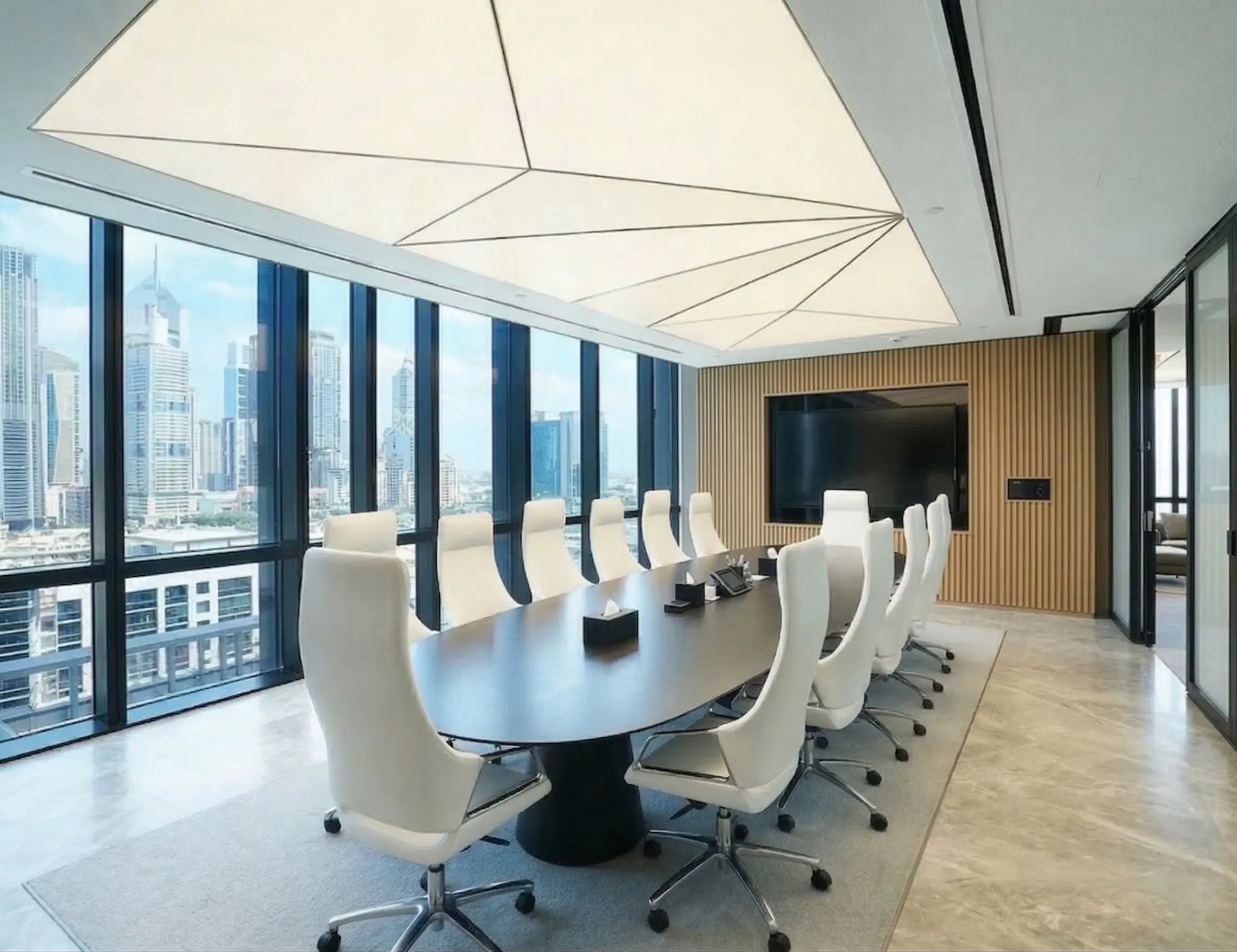
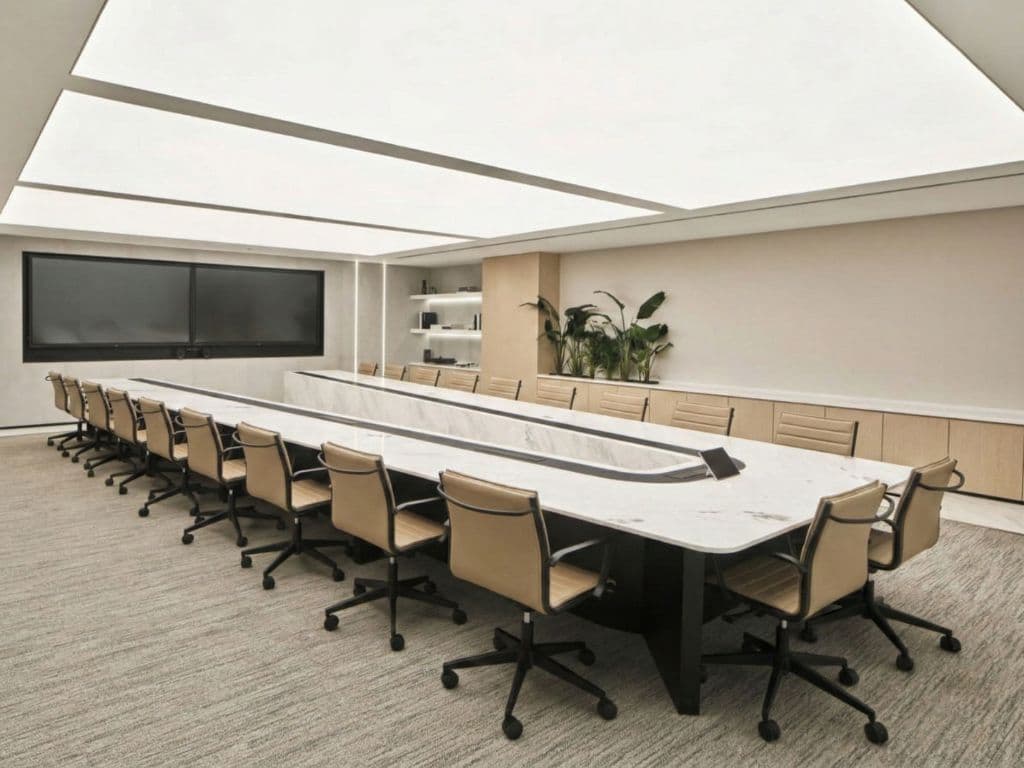
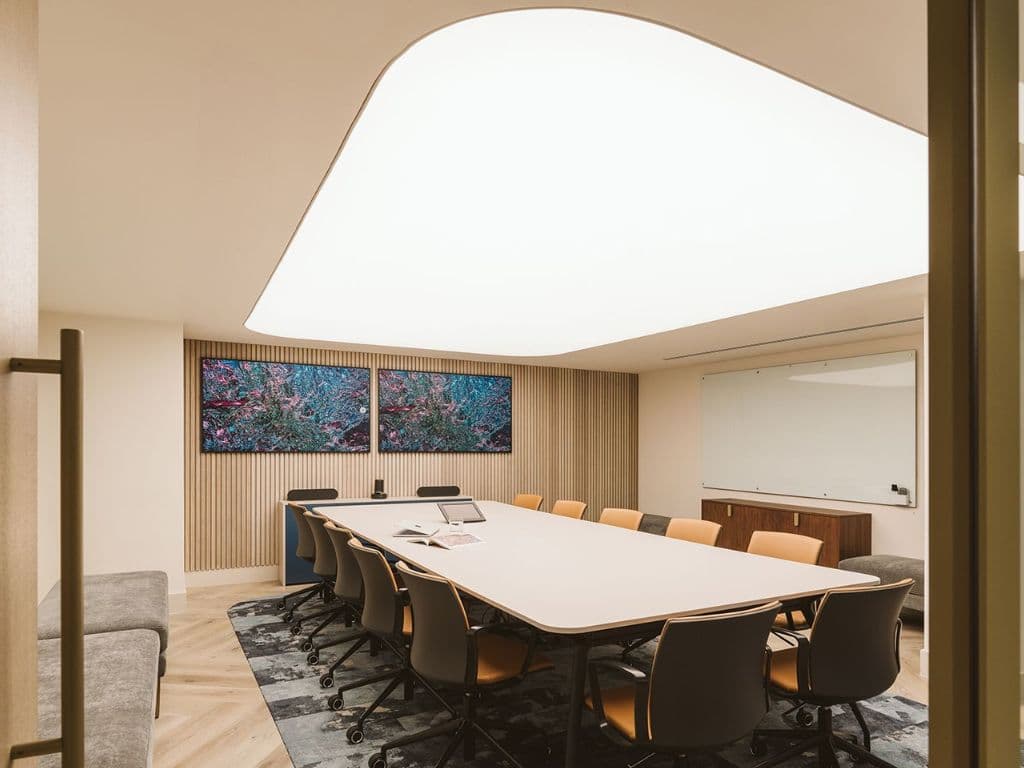
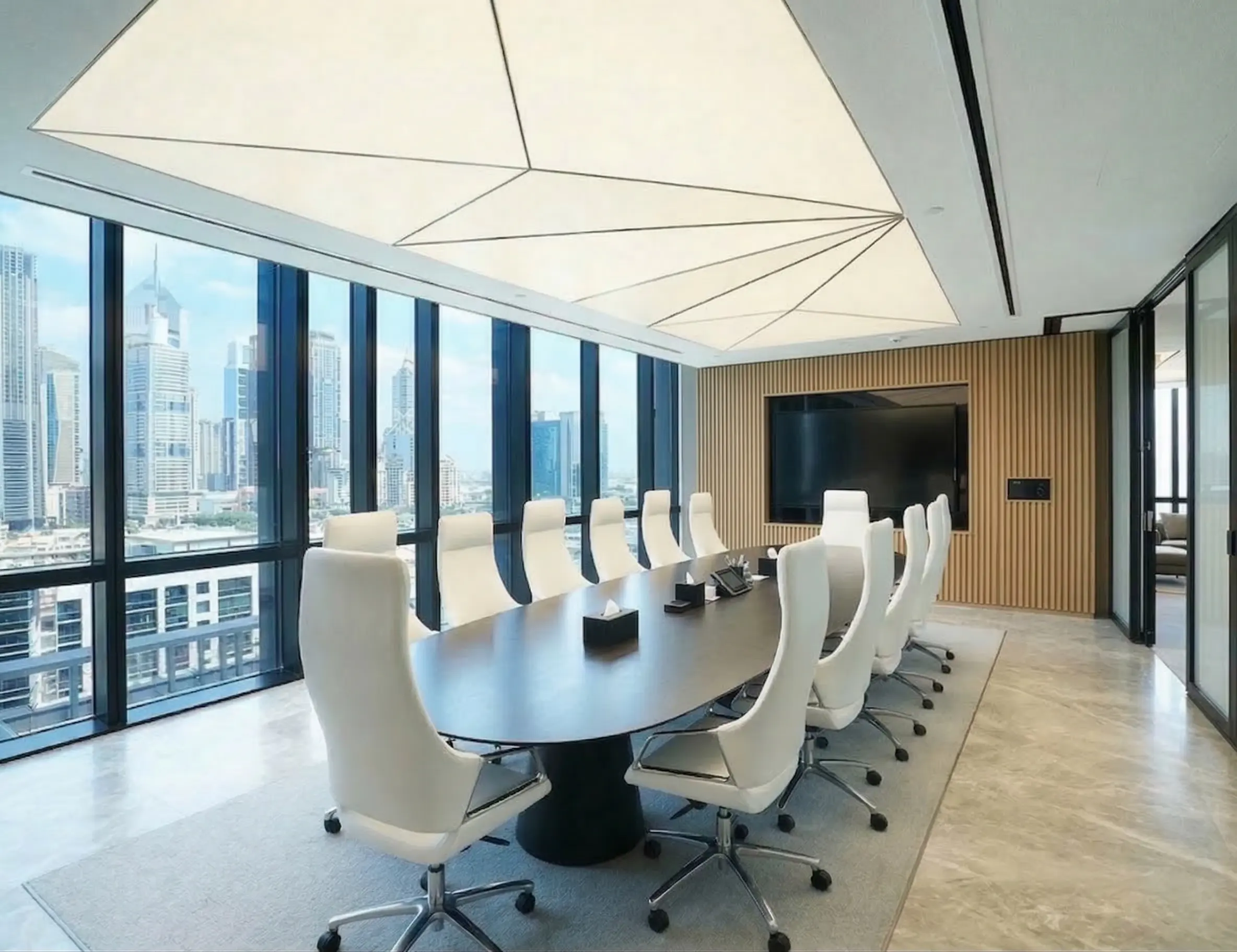
Daylight in a Boardroom With No Window

Challenge: An internal meeting room that clients described as oppressive, with a ceiling void only partly free of ductwork. Halo approach: Set the luminous panel out around the duct run, paint the plenum white, choose an LED pitch that suited the depth actually available, and tension a translucent membrane — an even, shadowless light with no visible fittings.


02

A Ceiling Fitted Over a Trading Floor

Challenge: Replacing a stained and cracked ceiling in a space that could not close, and where no wet trades were permitted. Halo approach: Survey and manufacture off site, then track and tension in the permitted overnight window — each zone handed back lit, clean and usable before opening.

03

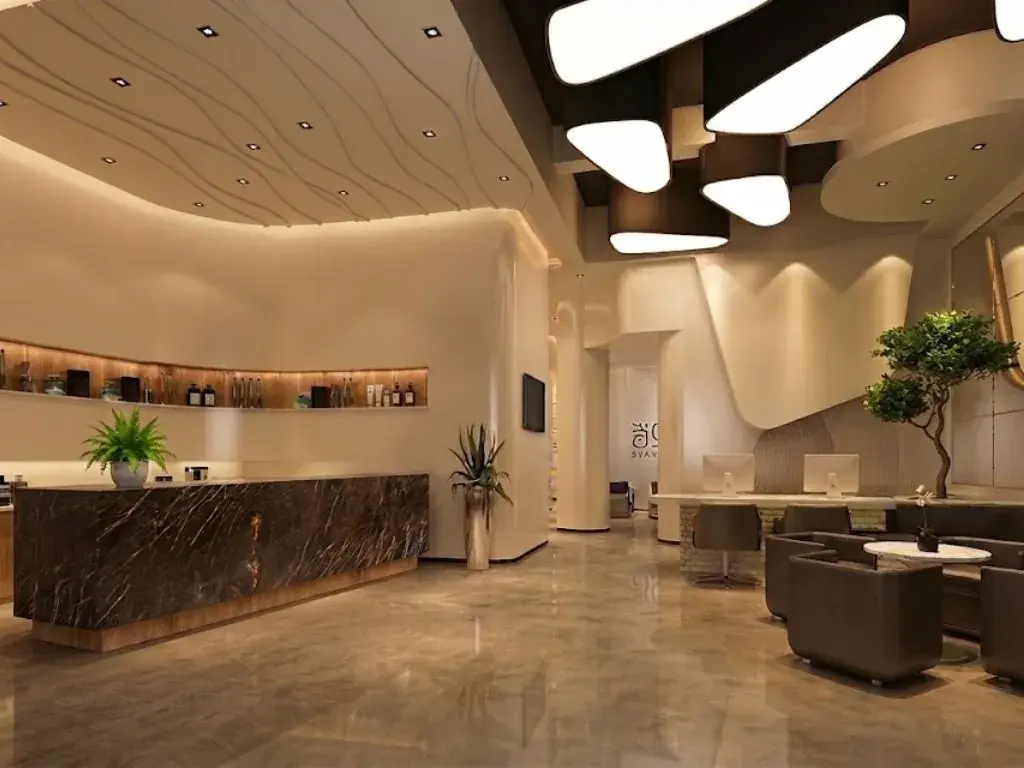
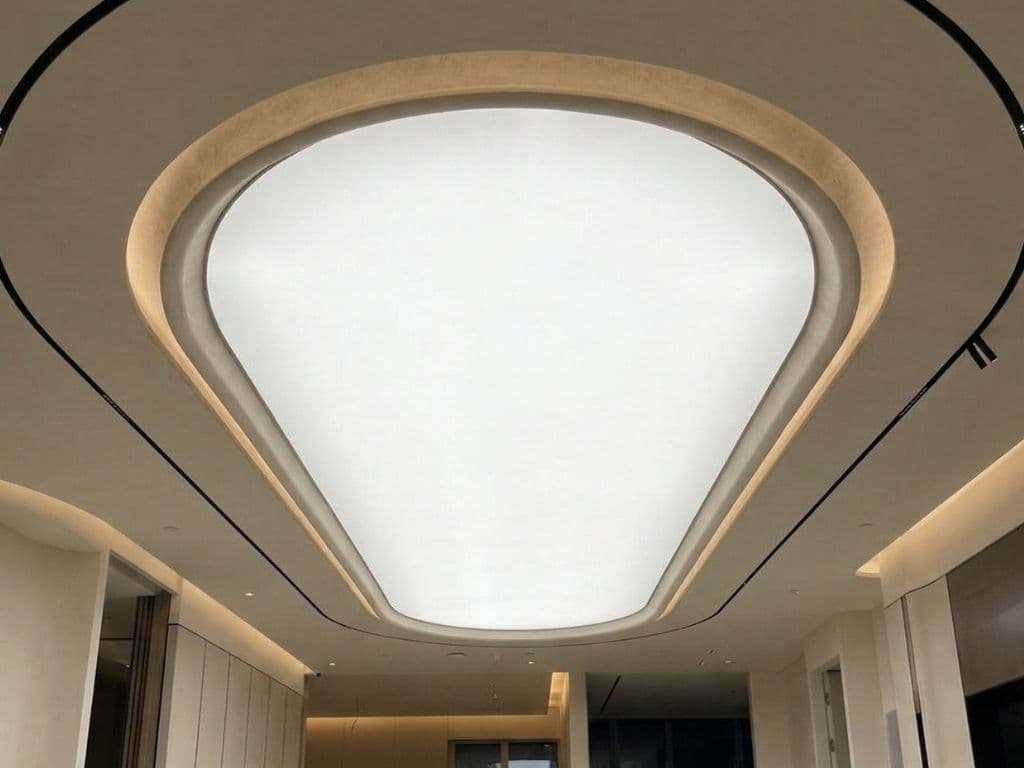
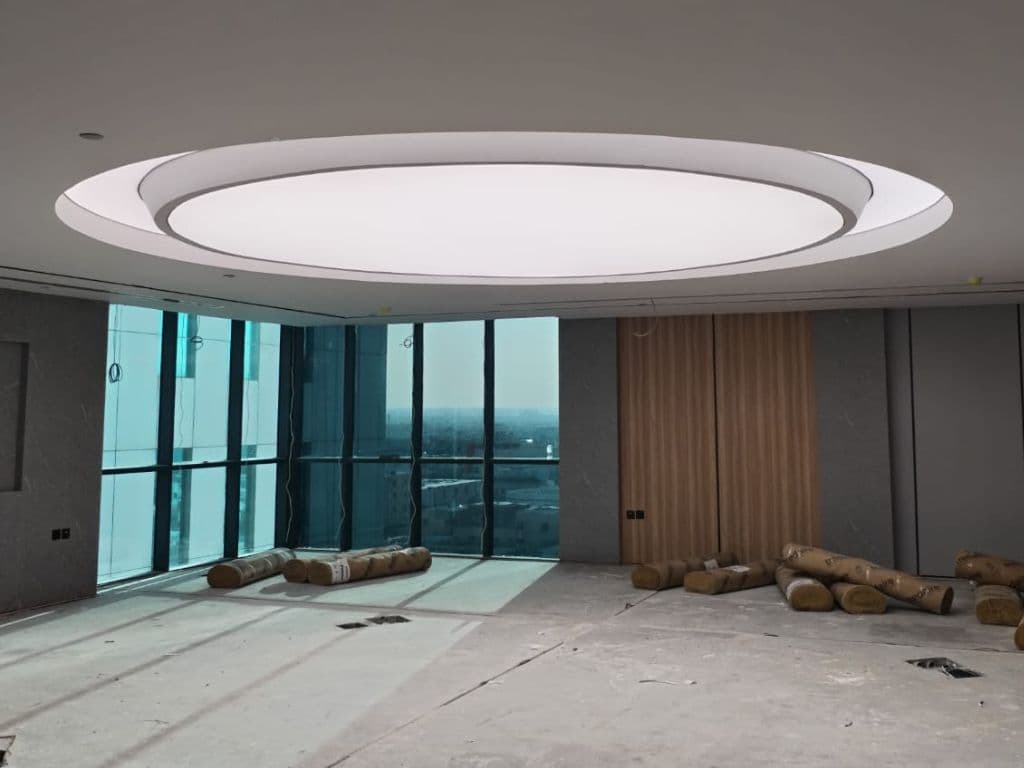
A Free-Form Panel Set Into a Gypsum Coffer

Challenge: A curved illuminated feature over a reception desk, where the membrane track and the plasterwork had to meet on a shape neither trade could set out alone. Halo approach: Draw the bulkhead and the track profile as one detail, build both with our own teams, and remove the interface argument entirely.

Stretch Ceiling Systems We Install in Dubai

One membrane material covers an unusually wide range of outcomes — a light source, a mirror, a printed sky, an acoustic absorber, a waterproof bathroom ceiling or simply a flawlessly flat plane over a ceiling nobody wants to demolish. These are the systems Halo surveys, manufactures and installs, all against the same drawings, programme and project manager.

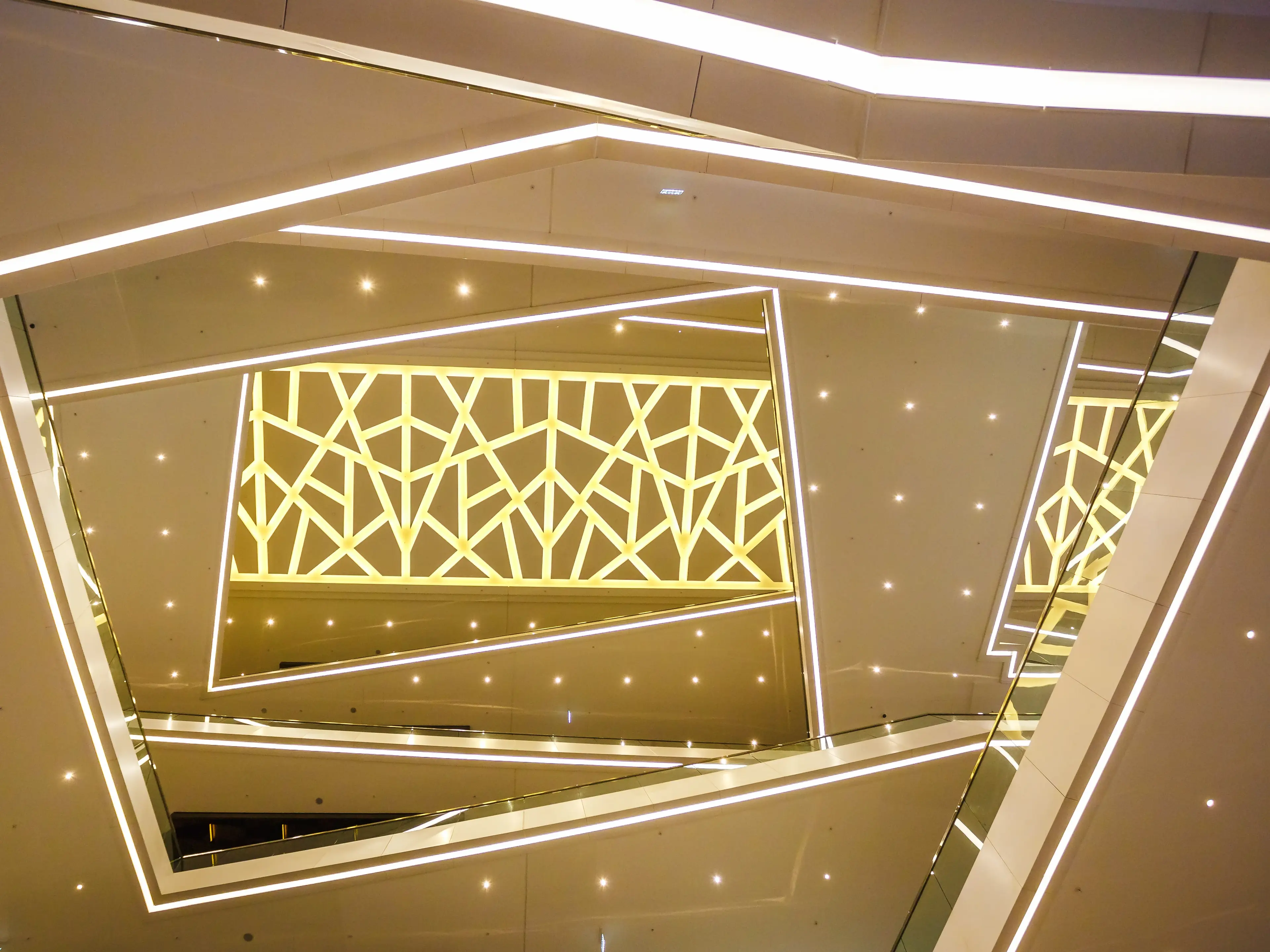
Backlit stretch ceiling in Dubai with geometric illuminated panels, gold fretwork and fibre-optic star points

Backlit & Translucent Luminous Ceilings

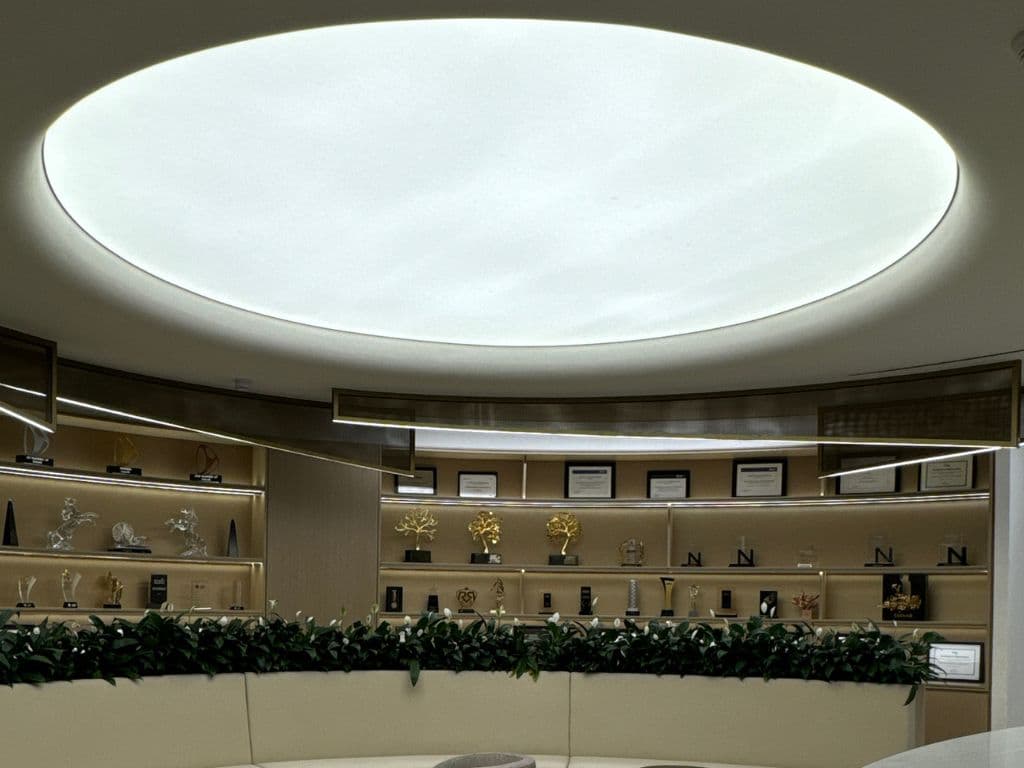
The reason most people arrive at a stretch ceiling. A translucent membrane is tensioned below a white plenum full of LED, and the ceiling stops being a surface and becomes a light source — even, shadowless, dimmable, and the only practical way to give a boardroom or a basement the feeling of a skylight. The engineering is in the void: an even glow needs enough depth between the LED and the membrane for the beams to overlap before they hit it. Too shallow, or the wrong LED pitch, and you get scalloping and hotspots that no amount of dimming hides. Halo sets the depth, the pitch and the plenum finish together, and keeps cable tray and duct out of the lit zone because anything dark in that void casts a shadow you will see forever.

  • Void depth and LED pitch set for an even, hotspot-free glow
  • Tuneable and dimmable circuits, run back to your control system
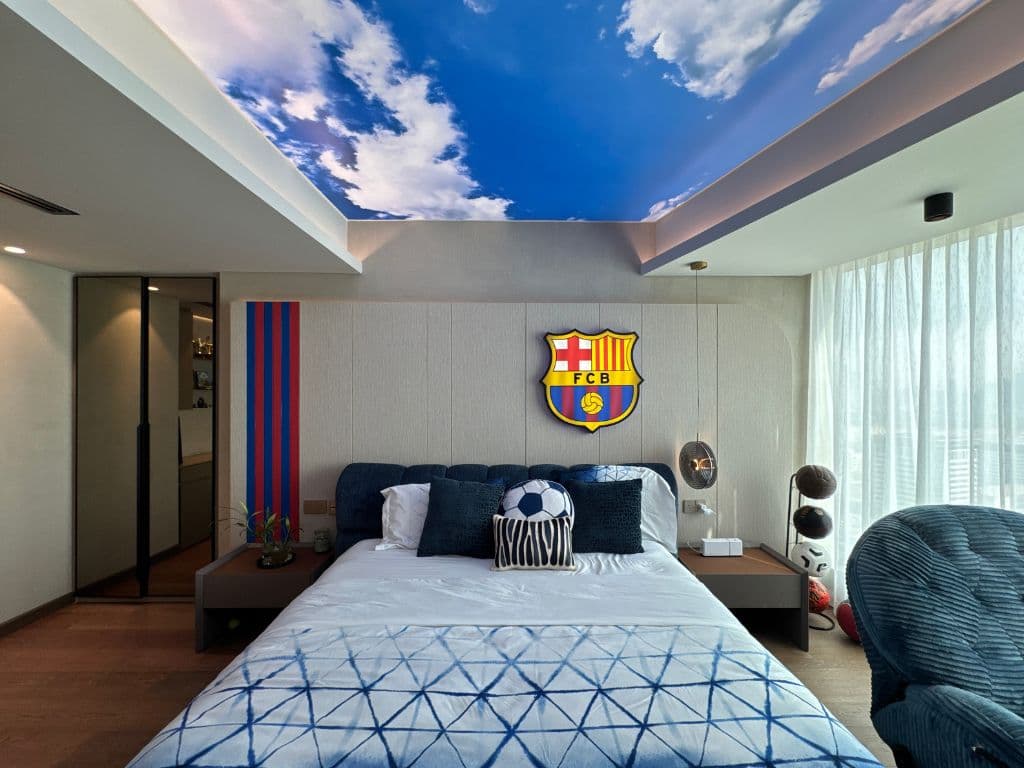
Printed sky stretch ceiling with clouds above a themed bedroom fit-out in Dubai by Halo

Printed, Sky & Starlight Ceilings

A membrane can be UV-printed at photographic resolution before it is stretched, which is how a windowless majlis gets a sky and a children’s room gets a galaxy. Two things decide whether it looks convincing or cheap. First, the artwork has to be produced for the finished, tensioned dimensions — printed flat and then stretched, an image distorts, so the file is pre-compensated. Second, on any ceiling wider than a single roll the seam positions have to be planned into the artwork rather than discovered in it. Starlight ceilings are a different build again: fibre-optic tails or fine LED points sit in the plenum behind a translucent membrane, so the sky is genuinely three-dimensional rather than a printed picture of one.

  • Artwork pre-compensated for tension, with seams planned into the image
  • Fibre-optic and LED star fields, with twinkle and colour-change options
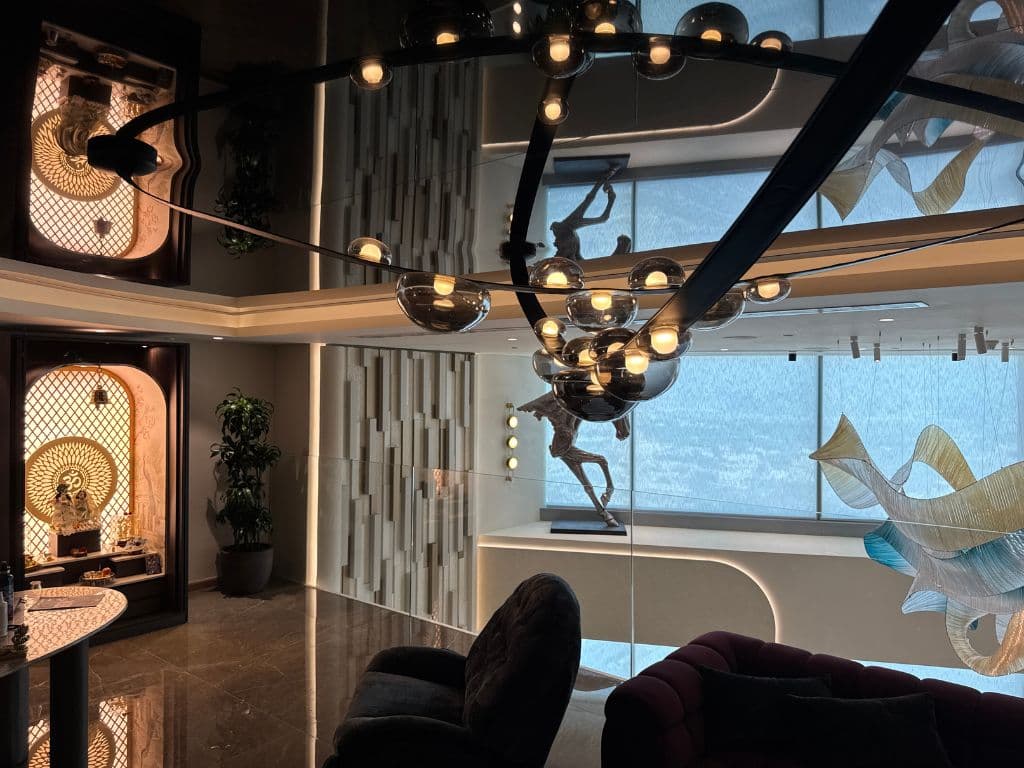
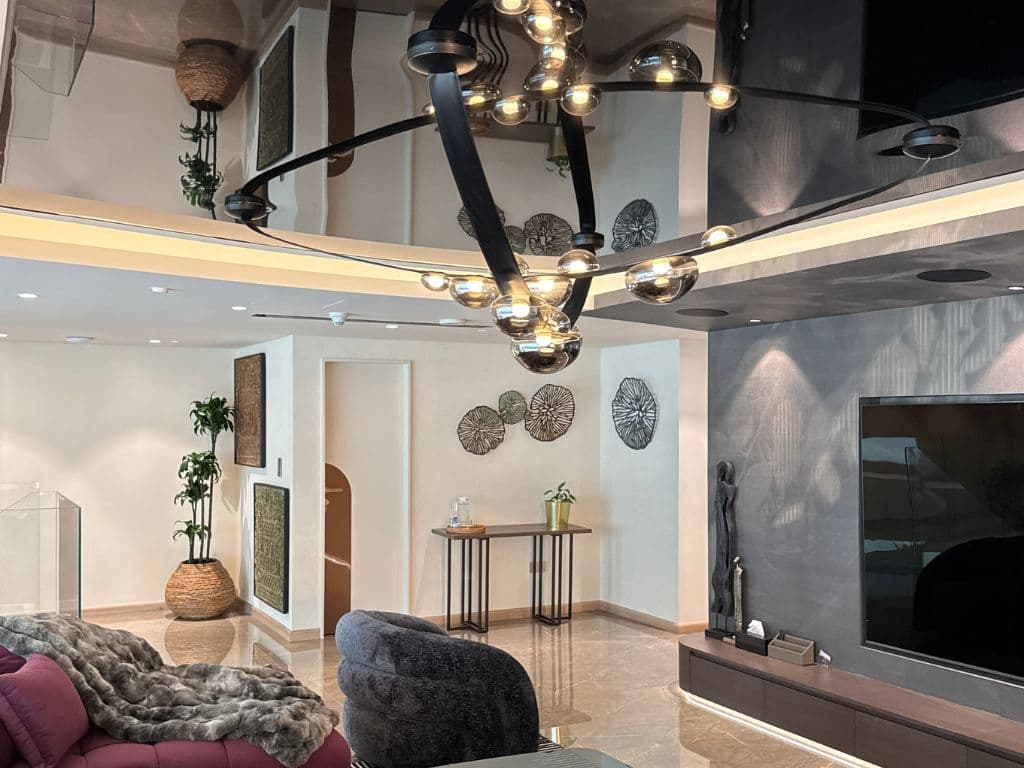
High-gloss dark stretch ceiling reflecting a chandelier and mashrabiya screening in a Dubai majlis

Gloss, Satin, Matt & Mirror Finishes

A high-gloss membrane behaves like a mirror: it doubles the apparent height of a room and throws light back down into it, which is why it turns up in small majlis rooms, lobbies and retail. It also reflects everything else — sprinkler heads, air grilles, the untidy top of a curtain track — so a gloss ceiling is a coordination decision as much as a finish one, and we will tell you when a room is not a candidate. Satin gives most of the reflectivity with far more forgiveness. Matt reads as a flawless painted plaster ceiling with none of the joints, cracks or shadowing that a painted ceiling develops. Suede and metallic finishes sit in between, and all of them arrive in a colour range a painted ceiling cannot match consistently.

  • Gloss, satin, matt, suede, translucent and metallic membranes
  • Reflection study before a gloss ceiling is specified, not after
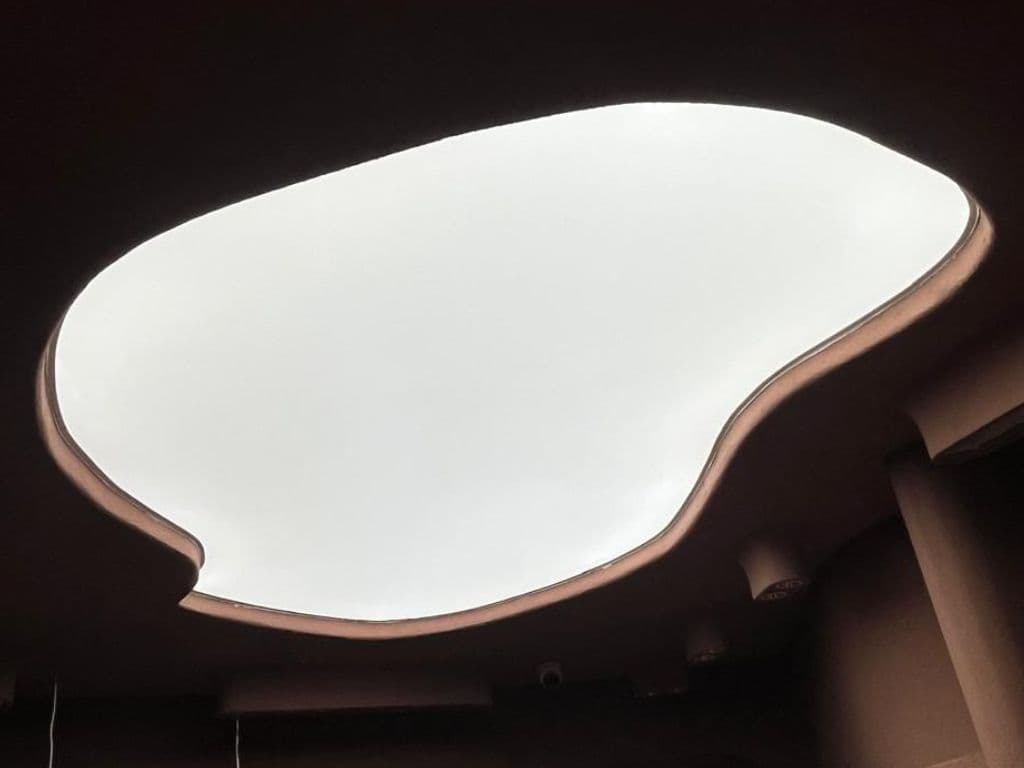
Free-form illuminated stretch ceiling panel with an organic curved edge in a Dubai interior

Curved, Domed & Free-Form Feature Ceilings

This is where a membrane beats every other ceiling material outright. Gypsum will curve, but a compound curve or an organic blob has to be framed, cut, jointed, filled, skimmed and then repainted every time it cracks. A stretch membrane is cut from a survey and tensioned into a track that follows any plan shape you can set out — a floating oval over a reception desk, a raised dome over a dining table, a wave that runs the length of a corridor, a slot that lights a wall. The framing behind it is normally a gypsum bulkhead we build first, which is why these two trades are quoted together and why the track detail is drawn before the bulkhead is set out rather than after.

  • Any plan shape, plus domes, waves and 3D-formed panels
  • Bulkhead and track detail drawn as one, so the frame fits the membrane
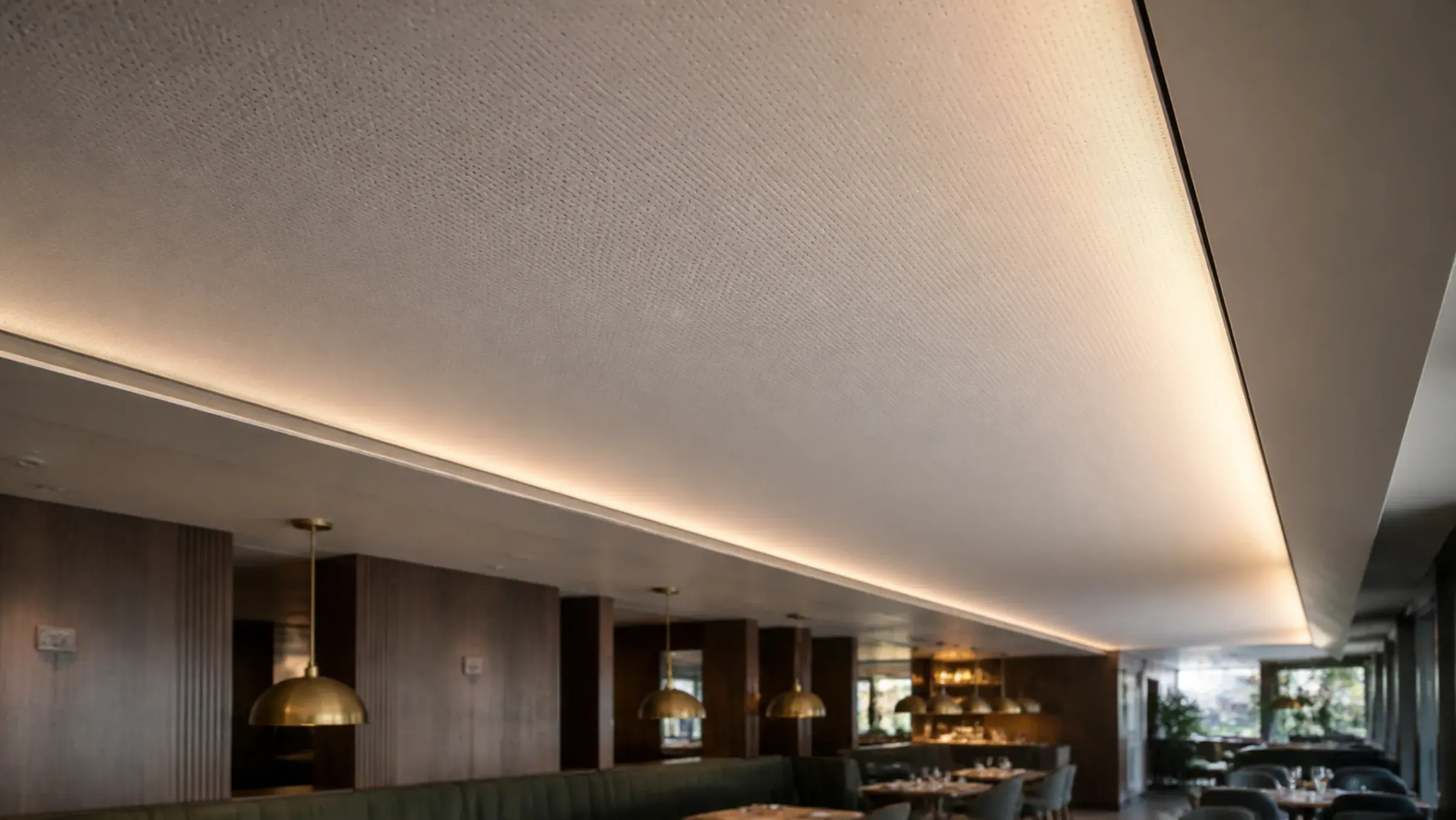
Micro-perforated acoustic stretch ceiling in a Dubai restaurant, the perforation reading as fine texture where cove light rakes across the membrane

Acoustic Stretch Ceilings

A micro-perforated membrane with acoustic insulation laid in the plenum behind it is one of the very few ways to get serious sound absorption while the ceiling still looks like a single flat plane. There are no tiles, no grid, no visible absorber — the perforations read as texture from below and the room stops ringing. That matters most in the rooms Dubai clients complain about after handover: hard-finished restaurants, open-plan offices with exposed soffits, double-height majlis rooms and anywhere glass, stone and gypsum have left nothing soft. The absorption comes from the perforation pattern plus the depth and density of what sits above it, so it is specified as a build-up rather than picked off a swatch.

  • Micro-perforated membrane over an acoustic plenum build-up
  • Absorption specified for the room, not assumed from the finish
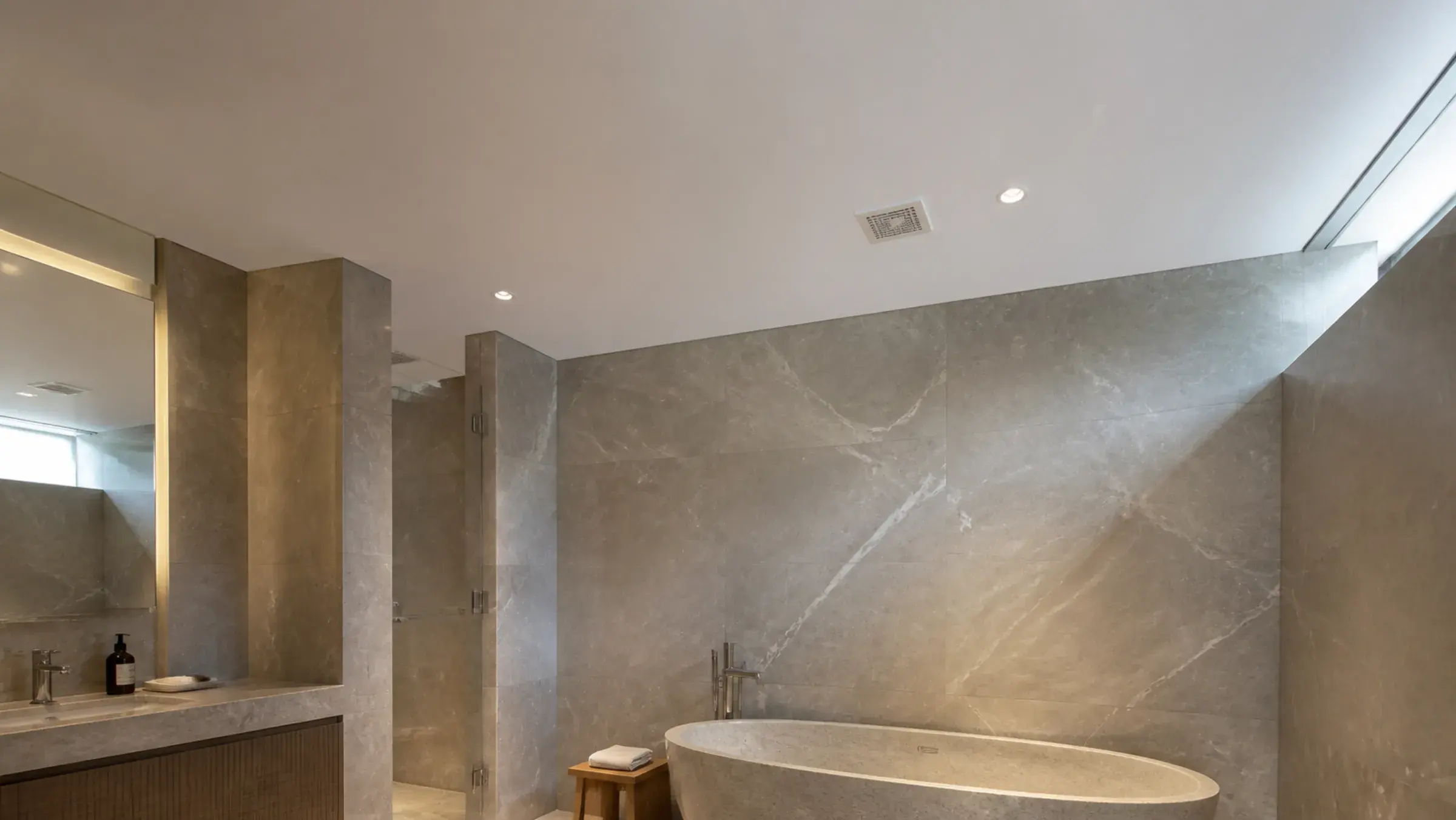
Satin stretch ceiling with a recessed downlight and flush extract grille above a stone-clad bathroom in Dubai

Bathrooms, Pools, Spas & Wet Areas

A PVC membrane does not absorb water, does not grow mould and does not stain, which makes it the sensible ceiling for a bathroom, a hammam, a spa or a pool hall where a painted gypsum ceiling starts to blister within a couple of seasons. It also has a property no other ceiling has, and in Dubai it earns its money: if the apartment above you leaks — a chilled-water pipe, a condensate tray, a failed seal — the membrane holds the water in a bulge instead of letting it through onto your furniture. It is drained, dried and re-tensioned, and the ceiling is the ceiling again. A gypsum ceiling in the same position is a skip and a repaint.

  • Non-porous, wipeable and mould-resistant in constant humidity
  • Contains a leak from above, then drains and re-tensions
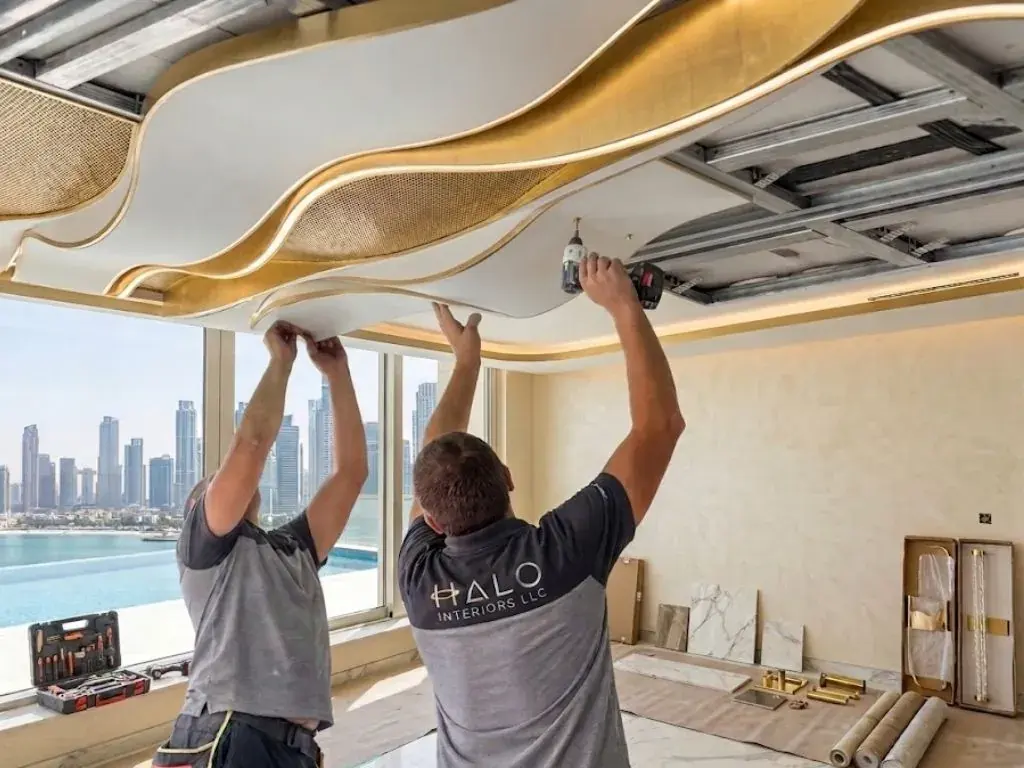
Two Halo installers tensioning a curved stretch ceiling membrane into place on a Dubai project

Fitted in Days, in Occupied Premises

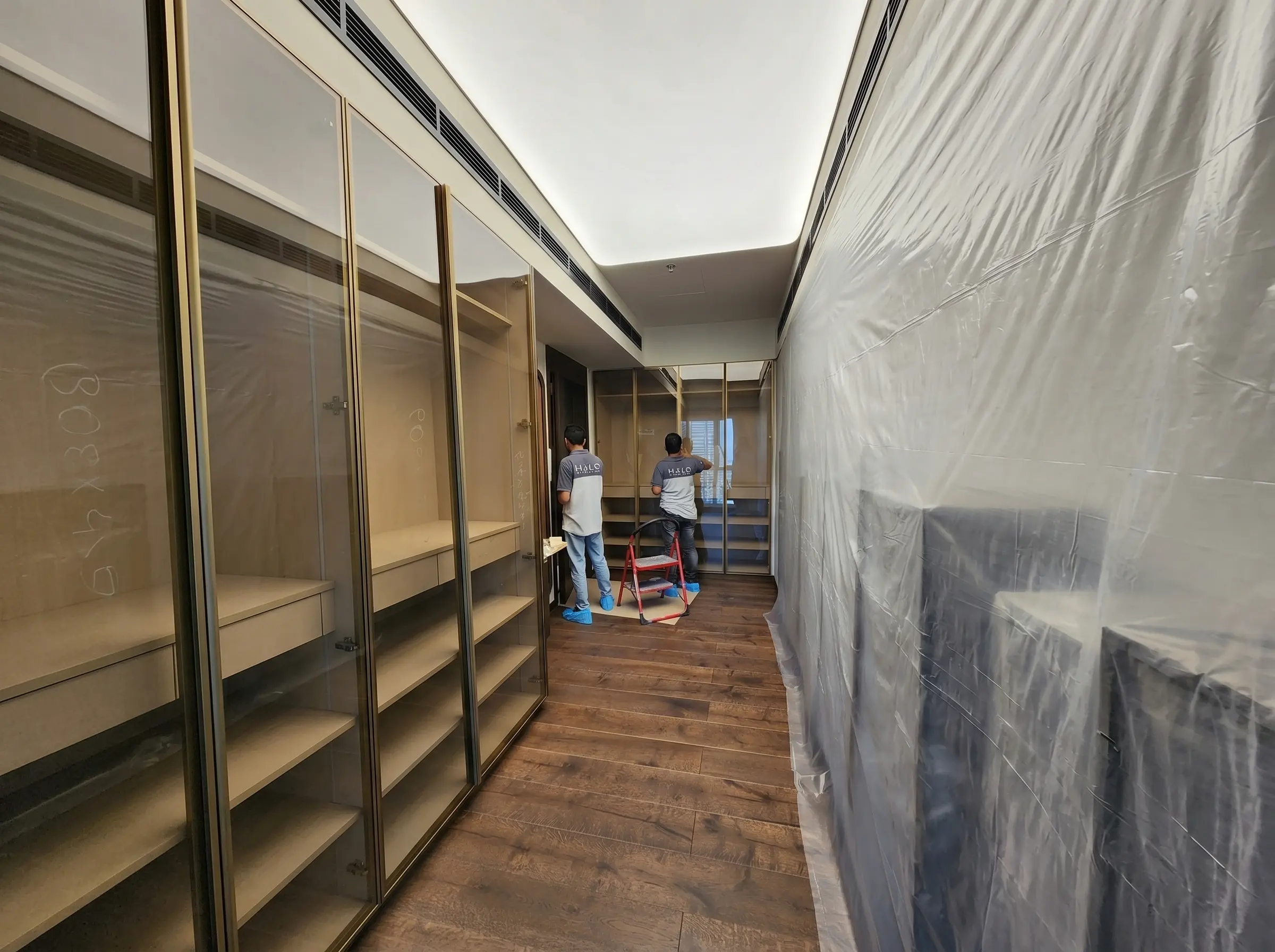
The membrane is manufactured off site from a measured survey — cut, welded and harpoon-edged in the workshop — so what happens in your room is track fixing and tensioning, not construction. There is no jointing compound, no sanding, no drying time and no painting, which means no wet trades, almost no dust and no smell. A single room is usually a one-day installation and a floor of offices is a matter of nights. That is why stretch ceilings get specified over an occupied hotel lobby, a trading shop or a family villa that nobody wants to move out of — and why an existing cracked, stained or sagging ceiling is often covered rather than demolished.

  • Manufactured off site, installed with no wet trades or dust
  • Night and weekend working in occupied and trading premises
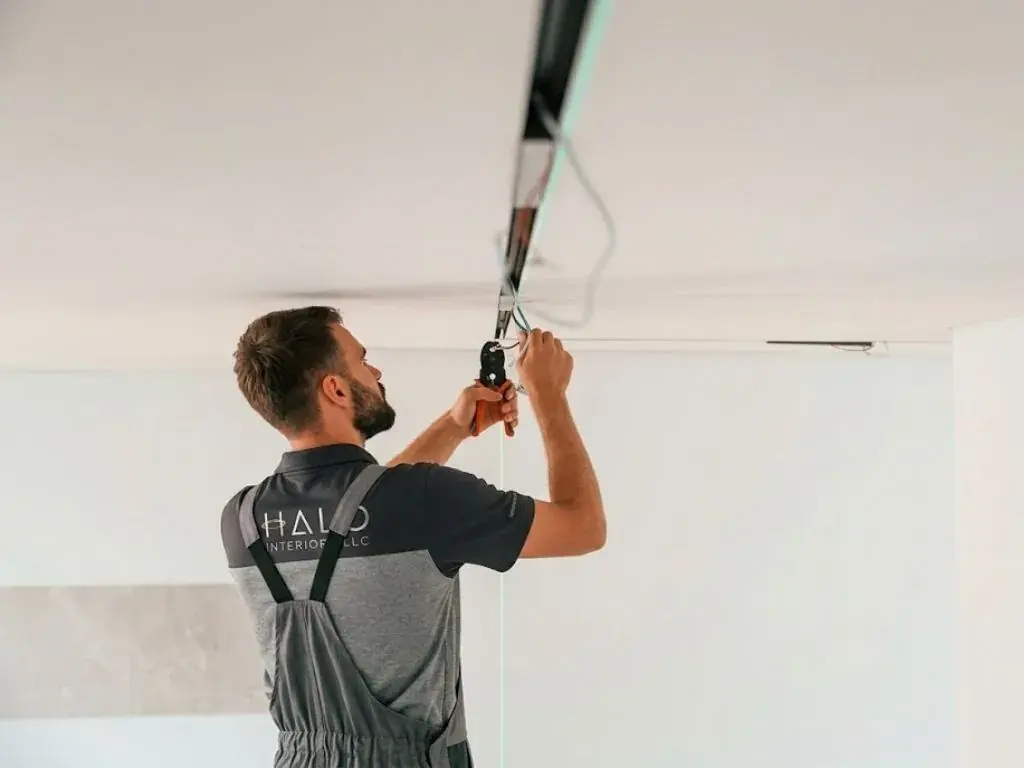
Halo technician releasing a stretch ceiling membrane from its perimeter track for void access

Access, Repair, Cleaning & Re-Tensioning

Every stretch ceiling Halo installs is demountable. The membrane unclips from its track, the void is open for the AC coil, the valve or the cable pull, and it clips back — which is a twenty-minute visit rather than cutting a hole in a gypsum ceiling and calling a painter afterwards. We also take on ceilings we did not install: re-tensioning a membrane that has slackened, patching or replacing a punctured panel, draining one that has taken a leak, cleaning a gloss finish that has gone hazy, and replacing failed LED behind a backlit panel. If a ceiling can be saved we will say so, and if the membrane is beyond repair we will say that too.

  • Demountable for AC, valve and cable access — clipped out and back in
  • Repair, re-tension, drain and cleaning, including ceilings we did not fit

One Contractor for the Frame, the Light and the Membrane

Stretch ceilings fail at the interfaces far more often than they fail as a material. A designer specifies a backlit panel into a void that turns out to be ninety millimetres deep. A gypsum subcontractor builds the bulkhead before anyone has told them which track profile it has to receive. The electrician sets an LED pitch that suited the last job. The membrane installer arrives last, finds none of it coordinated, and tensions a ceiling that shows every one of those decisions for the next decade.

Halo runs all of it. Our own gypsum team builds the bulkhead, our own electricians install the plenum lighting, and our own crew surveys, manufactures and tensions the membrane — alongside the gypsum ceilings and partitions, MEP and joinery that the rest of the room needs. We have been delivering interiors in Dubai since 1996, and ceilings sit inside the same team as the fit-out work rather than being bought in.

Survey, drawings, framing, lighting, membrane and certification delivered as one scope under one project manager.

Discuss Your Ceiling

Survey, design and setting out

Laser survey of the real room, void depth check, track line, seam and cut-out positions, and a reflected ceiling plan you can approve before anything is manufactured.

Bulkheads and framing

Where the membrane needs a frame, our own gypsum team builds the bulkhead, the shadow gap or the coffer that the track fixes into — so the two trades are not blaming each other.

Lighting, LED and services

Plenum LED, drivers, dimming, sprinklers, detectors, diffusers, grilles and speakers are coordinated into the membrane with the right reinforcing rings, not cut in afterwards.

Manufacture, install and hand over

Cut, welded and harpoon-edged off site, then tensioned on site by our own crew, commissioned and handed over with the fire classification certificate and care instructions.

Why Dubai Clients Choose Halo as Their Stretch Ceiling Contractor

Quotations from stretch ceiling companies in Dubai are difficult to compare, because the same headline rate per square metre can hide very different assumptions about the LED, the framing, the certification and the number of cut-outs. These are the five things worth testing on every contractor you shortlist, including this one.

Measured, Not Estimated

A membrane is manufactured to the room to the millimetre, and a room in a Dubai tower is very rarely square. We survey with a laser, check the void depth against the deepest service in it, and set out the seams and the cut-outs before anything is welded — because a membrane cannot be trimmed on site the way a board can.

The Lighting Is Designed With the Ceiling

Backlighting is a photometric problem, not a shopping list. Void depth, LED pitch, beam angle, plenum colour and membrane translucency all interact, and getting any one of them wrong produces the scalloped, patchy ceiling you have seen in a mall food court. Halo designs the light and the membrane as one item.

Fire Classification You Can Hand to Civil Defence

A commercial ceiling needs a membrane with a surface-spread-of-flame classification, and the certificate needs to name the material actually installed. We supply certified membranes and issue the documentation at handover, and we coordinate sprinkler and detector positions rather than quietly sealing a void behind them.

We Build the Frame the Track Fixes To

Most stretch ceiling failures in Dubai are not membrane failures — they are a track screwed to a bulkhead that was not built straight, level or rigid enough to be tensioned against. Halo builds the gypsum bulkhead and installs the membrane, so there is one contractor and one line of responsibility.

Priced Per Square Metre, With the Variables Named

Stretch ceiling price in Dubai is driven by the finish, the perimeter length, the number of cut-outs and whether a lit plenum has to be built. Our proposals state all four, so you can compare a quotation line by line instead of comparing two different scopes at the same headline rate.

Our Stretch Ceiling Process

Consultation & Reference Images

We start from what you want the ceiling to do — light the room, hide a mess, quieten it, survive a wet area or simply look extraordinary — and from any reference images you have, which usually tell us more than a specification would.

Site Survey & Void Check

Laser measurement of the room, confirmation of the void depth below the deepest duct, beam or pipe, the condition and rigidity of the perimeter, and the position of every sprinkler, detector, grille and speaker that has to come through.

Finish, Lighting & Reflected Ceiling Plan

Membrane finish and colour, translucency, LED layout and pitch, track and perimeter detail, seam positions and cut-outs are drawn into a reflected ceiling plan and an itemised quotation per square metre.

Bulkheads, Framing & First Fix

Gypsum bulkheads, coffers and shadow-gap details are built, the plenum is painted, LED and drivers are installed and the services are brought to their final positions and tested.

Manufacture & Tensioning

The membrane is cut, welded and harpoon-edged in the workshop to the surveyed dimensions, then tensioned into the track on site — usually in a single day per room, with no wet trades.

Commissioning, Certificates & Handover

Lighting is commissioned and dimming set, cut-outs and trims are checked, the ceiling is cleaned, and you receive the fire classification certificate, the care instructions and the offcut record for any future repair.

Stretch Ceiling Price in Dubai

Stretch ceilings are quoted per square metre, and the ranges below are where Dubai projects generally fall. They are indicative market figures to help you plan, not a quotation — the finish, the perimeter length, the number of cut-outs and whether a lit plenum has to be built are what actually decide your rate.

Matt, satin or gloss membrane, plain roomFrom AED 150 to AED 300 per m²
Printed, sky or starlight ceilingFrom AED 350 to AED 700 per m²
Translucent backlit panel, including LED and plenumFrom AED 450 to AED 900 per m²
Typical single-room feature ceilingFrom AED 8,000 to AED 35,000

Plain membrane over an existing ceiling or soffit

Normally included
Survey, manufacture to size, perimeter track, tensioning, standard cut-outs for existing downlights and detectors, and making good at the track line.
Normally excluded
New bulkheads, lighting supply and alteration, and any repair to the substrate the track fixes into.
What moves the cost
Perimeter length relative to area — a small, complex plan shape costs far more per square metre than a large simple one, because track and labour are priced by the linear metre.

Backlit or translucent luminous ceiling

Normally included
Translucent membrane, plenum preparation and white finish, LED, drivers, dimming provision, the void depth set for an even glow, and commissioning.
Normally excluded
Building the void where none exists, structural alterations, and integration into a third-party control system beyond the agreed interface.
What moves the cost
Available void depth is the dominant cost item. A shallow void needs a denser LED layout or a specialist wide-beam fitting to avoid hotspots, and both cost more than depth would have.

Printed, sky and starlight ceilings

Normally included
Artwork preparation and pre-compensation for tension, UV printing, seam planning, membrane installation and — for starlight — the fibre-optic or LED point field and its driver.
Normally excluded
Licensing of third-party imagery, and bespoke artwork commissioned from an illustrator or photographer.
What moves the cost
Print area, the resolution the viewing distance demands, and whether the design can be produced within a single membrane width or has to be planned around welds.

Curved, domed and free-form feature ceilings

Normally included
Setting out, the gypsum bulkhead or frame that carries the track, specialist track profiles, 3D-formed or multi-plane membranes and the trims between planes.
Normally excluded
Suspended structure and steelwork where a feature is too large or too heavy for a standard hanger system.
What moves the cost
The number of separate planes and trims, and the tightness of the radii — a curve the track has to be set into by hand is a labour item, not a material one.

Wet areas, pools, spas and bathrooms

Normally included
PVC membrane suitable for constant humidity, corrosion-appropriate track and fixings, sealed cut-outs at extract and lighting positions and the perimeter detail against tiled surfaces.
Normally excluded
Ventilation and extract works, tanking, and rectification of the leak or condensation problem that damaged the previous ceiling.
What moves the cost
Whether the perimeter can be fixed into a sound substrate behind the tiling, and the extent of extract and downlight penetrations.

Repair, re-tensioning and maintenance

Normally included
Attendance, releasing and re-tensioning the membrane, draining water held after a leak, patching or replacing a damaged panel, cleaning and replacing failed LED behind a backlit panel.
Normally excluded
The cause of the leak itself, which is normally a plumbing or base-build matter, and the replacement of a ceiling that has been cut or over-stretched beyond recovery.
What moves the cost
Whether the original membrane, colour and offcuts can be matched. A panel with no record behind it is usually a full replacement of that plane rather than a patch.
  • Every figure above is an indicative market range, not a quotation. Stretch ceiling work is priced per square metre against a surveyed room, a chosen finish and a defined lighting scope.
  • Ranges are stated exclusive of VAT, which is applied at the prevailing UAE rate.
  • Perimeter length matters as much as area. Two ceilings of the same square metreage can differ by half again in price if one is a rectangle and the other is a set of small curved panels.
  • Backlighting is normally the largest single variable, because the LED, the drivers, the plenum preparation and the void depth all move together.
  • A site visit is required before a price is issued. The void depth, the rigidity of the perimeter and the position of the sprinklers are the three things that cannot be established from a photograph.

What Moves the Rate on Your Ceiling

Two ceilings of identical area can differ by half again in price. The reasons are almost always the same six: the finish and its translucency, the perimeter length relative to the area, the clear void depth available for backlighting, the number of service penetrations, whether a bulkhead has to be built to fix the track to, and the access and working hours the building permits.

That is why the ranges above are a starting point rather than an answer. After the survey you receive an itemised quotation against a defined scope and a reflected ceiling plan, so you can compare it line by line with any other stretch ceiling company in Dubai.

Finish and translucency

Matt and satin sit at the bottom of the range, gloss above them, and translucent backlit material at the top — before a single LED is counted.

Perimeter length, not just area

Track and installation labour are priced by the linear metre, so a complex plan shape costs far more per square metre than a simple one.

Available void depth

A shallow void forces a denser LED layout or a specialist fitting to get an even glow. Depth is the cheapest way to buy a good backlit ceiling.

Cut-outs and service penetrations

Every downlight, sprinkler, detector, grille and speaker needs a reinforcing ring bonded before tensioning. They are counted, not absorbed.

Bulkheads and framing required

If there is nothing rigid to fix a track to, a gypsum bulkhead has to be built first — which is a separate scope with its own programme.

Access and working hours

Occupied offices, trading retail and hotel public areas usually mean night work, permits and a service-lift booking rather than a daytime programme.

How Long Does a Stretch Ceiling Take?

The installation itself is fast — normally a day per room. What sits in front of it is the survey, the drawings, any framing or first-fix lighting work and the manufacture of the membrane. The phase ranges below are what we plan against.

  1. Consultation and site survey
    2 – 5 days

    Room measurement, void depth check, perimeter condition and service positions.

  2. Finish selection, RCP and quotation
    1 – 2 weeks

    Membrane and colour, lighting layout, track and seam setting out, and an itemised rate.

  3. Bulkheads, plenum and first-fix lighting
    1 – 3 weeks

    Only where framing is required. Gypsum work, plenum painting, LED, drivers and service positions.

  4. Membrane manufacture
    1 – 3 weeks

    Cutting, welding and harpoon-edging to the surveyed dimensions; printing where the design calls for it.

  5. Installation and tensioning
    1 – 5 days

    Track fixing and tensioning on site, typically a day per room, with no wet trades and minimal dust.

  6. Commissioning, cleaning and handover
    1 – 3 days

    Lighting commissioned, trims checked, ceiling cleaned, certificates and care notes.

Phases overlap. Membrane manufacture runs while the bulkheads and first-fix lighting are being installed, so the sum of the ranges above is not the project duration.

Your Ceiling Project Is Protected

A membrane is welded to fixed dimensions and cannot be re-cut on site, so the commitments below sit around the work from the survey onwards rather than being offered at the end of it.

A reflected ceiling plan before manufacture

You approve the track line, the seam positions, the cut-outs and the lighting layout on a drawing. A membrane is welded to those dimensions and cannot be re-cut afterwards, so the drawing is the commitment.

Certified membranes, documented

The material installed carries a surface-spread-of-flame classification, and the certificate naming that material is handed over with the project rather than promised and forgotten.

Milestone-based payments

Payments are staged against defined, inspected milestones rather than calendar dates, so you are never paying substantially ahead of the work that has actually been completed.

A named project manager

One person owns the ceiling from survey to handover, coordinates the gypsum, electrical and membrane stages and is the number you call if something is not right.

Offcuts and records kept

The membrane batch, colour and offcuts are recorded against your project, which is what makes a future repair a patch rather than a full replacement of the plane.

Reachable after handover

Ceilings are demountable and occasionally need attention. The project team stays contactable, and Halo has been working in Dubai since 1996 and is not difficult to find.

A New Ceiling Without Moving Out

The reason stretch ceilings get specified over occupied homes, trading shops and working office floors is not the finish — it is that there are no wet trades. No jointing compound, no sanding, no paint and no drying time changes what is possible in a room that has to stay in use.

One Room, One Day

Because the membrane is manufactured off site, most rooms are stripped, tracked, tensioned and handed back inside a single working day rather than a week of trades.

Furniture Sheeted, Not Removed

There is no jointing compound and no sanding, so protection is sheeting and a clean-down rather than emptying the room and repainting it afterwards.

Zone-by-Zone in Larger Floors

Offices, showrooms and hotel public areas are split into zones so each one hands back complete and lit, and the space stays usable throughout.

Night and Weekend Working

In malls, hotels and trading premises the work moves into the permitted window, with the service lift booked and materials routed the way the building requires.

Low Noise, Low Dust, No Smell

Track fixing is the only noisy operation, and the heat gun used to tension a PVC membrane produces warmth rather than fumes — which is why this work is possible over occupied floors at all.

Ceiling Projects We Deliver

Choose the path that reflects where you are today. The survey confirms the right technical scope from there.

01

A Feature Ceiling for One Room

A majlis, a dining room, a reception or a boardroom that needs one extraordinary plane — backlit, printed, curved or gloss — surveyed, manufactured and installed in days.

Plan a Feature Ceiling
02

Cover a Failed or Crowded Ceiling

Cracked plaster, water staining, a sagging gypsum ceiling or a void full of exposed services, resolved without demolition, wet trades or moving out.

Discuss a Ceiling Replacement
03

Commercial & Hospitality Ceilings

Lobbies, retail units, restaurants, clinics and offices — including acoustic membranes, night working and coordination with fire and MEP consultants.

Talk to Our Commercial Team
04

Repair, Re-Tension or Clean an Existing Ceiling

Slackened membranes, punctured panels, water held after a leak, hazy gloss and failed LED behind a backlit panel — including ceilings installed by someone else.

Request a Ceiling Repair

What Our Clients Say

Google

Timur G

Google Review

We engaged Halo Interiors for a turnkey renovation project at our property in Dubai Creek Harbour. Halo handled the entire project including design, procurement, permits, and execution of the works. Halo worked to a tight deadline and delivered a stunning design, which they then implemented to a very high standard. The quality of execution was head and shoulders above anything else I have seen in Dubai, with attention to every detail and very thorough quality control. As a client, I also felt that Halo were very honest in our dealings and this really made a difference. The pricing was also competitive and fully transparent. I cannot recommend Halo highly enough.

See full Google review
Google

AJ Boelens

Google Review

I am so thankful Jason and Zishan from Halo for their help to conduct a property inspection and support us in how to handle a renovation project that went terribly wrong. If I could do things over again, I would have consulted with Halo prior to our renovation project and would have asked for their guidance and project management support. There are a lot of shady contractors in Dubai apparently and these guys are the only honest people you can rely on. I would give them 6 stars if I could!

See full Google review
Google

limelight interors

Google Review

We have had the pleasure of working with Halo Interiors on three different projects, and the experience has been nothing short of exceptional. Our clients have praised the quality and service provided, and we have not faced a complaint. Their premium quality joinery speaks for itself. A special mention to Huzefa, the project manager, who expertly handled our most recent renovation. I highly recommend Halo Interiors to anyone seeking top-notch craftsmanship and reliable service.

See full Google review
Google

Mansi shah

Google Review

We contracted Halo for our first villa upgrade project in early 2022 and we have been using their services since then. I cannot but help appreciate the extra effort they take to ensure all our requirements are addressed. Extremely professional and reliable. I would recommend them without hesitation!

See full Google review

4.8

1,200+ projects completed

Stretch & Feature Ceilings Across Dubai

Halo installs stretch ceilings across Dubai — Emirates Hills, Palm Jumeirah, Dubai Hills Estate and Arabian Ranches among the villa communities, Downtown Dubai, Dubai Marina, Business Bay and JLT among the towers, and DIFC, Sheikh Zayed Road, Al Barsha and DIP for commercial and hospitality work. Every building brings its own access rules, permitted working hours and service-lift booking, which is why the installation route is confirmed for your specific address rather than assumed from the district.

Halo works with homeowners, designers, architects and commercial operators across Dubai, and has delivered projects for Dubai Properties, Jumeirah, Majid Al Futtaim, One&Only, Rotana, Sheraton and Siemens.

Across DubaiStretch and feature ceiling enquiries city-wide
Select a community to locate it

Villa Communities

Apartment & Tower Districts

Commercial & Hospitality

Your building is not listed? Share the location, the room dimensions and a photo of the existing ceiling so our team can confirm the void depth and the right system.

Check My Ceiling

What a Stretch Ceiling Actually Buys You

Very few clients want a membrane. They want one of the six things below, and a membrane happens to be the most direct way to get it.

Daylight where there is no window

A luminous ceiling is the only convincing answer for an internal boardroom, a basement majlis or a windowless treatment room — an even, shadowless light that reads as sky rather than as fittings.
Hide a ceiling you cannot fix

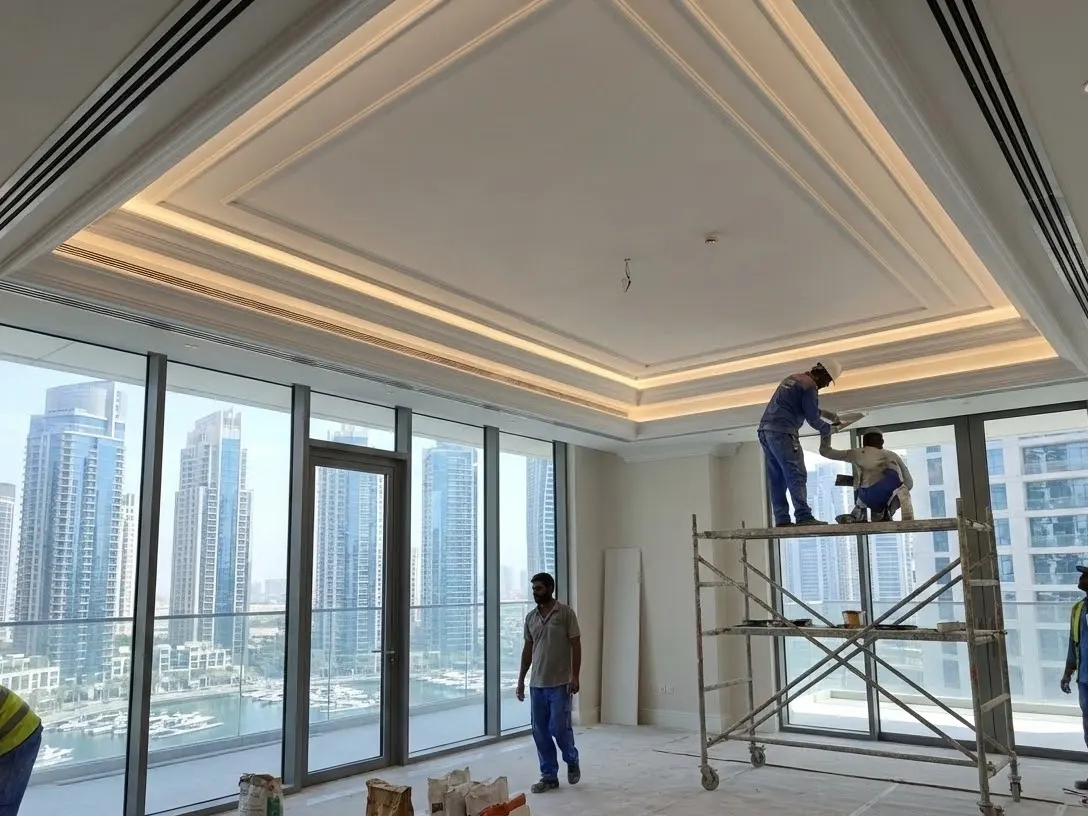
Cracked plaster, a stained or sagging gypsum ceiling, a spalled concrete soffit or a void crowded with services disappears behind a plane that is flat, clean and demountable.

A new ceiling without moving out

No jointing, no sanding, no paint and no drying time. A room is normally handed back the same day, which is what makes this viable in an occupied home, a trading shop or a working office.

Survive humidity and a leak from above

Non-porous, mould-resistant and wipeable — and if the flat above you leaks, the membrane holds the water instead of releasing it into the room.

Quieten a hard room without a grid ceiling

A micro-perforated membrane over an acoustic plenum absorbs sound while still reading as one flat, uninterrupted plane. No tiles, no exposed grid, no acoustic panels on the walls.

A feature that photographs

Hospitality, retail and showroom clients specify these ceilings because they are the element people photograph — and because a ceiling is the one surface in a commercial interior nobody else has used.

Stretch Ceiling or Gypsum Ceiling?

This is the question almost every enquiry is really asking, and a page selling one of the two answers is not the most trustworthy place to read it. So here is the comparison written by a contractor who installs both, including the cases where the answer is gypsum and we will quote you gypsum.

When a stretch ceiling is the right answer

You want the ceiling to emit light rather than hold fittings; the room has to stay in use; the existing ceiling is cracked, stained or crowded with services; the shape is curved or organic; the space is humid; or the void will need to be opened again for maintenance. In each of those, a membrane does something board genuinely cannot.

Related Halo capability

Membrane survey, manufacture and installation, with decorative finishes for the surfaces around it

When a gypsum ceiling is the right answer

You want a conventional flat painted ceiling at the lowest cost per square metre; the ceiling has to carry heavy loads such as large chandeliers, projector mounts or fixed joinery; you need a fire-rated ceiling as part of a tested floor assembly; or the design is a set of deep coffers and cove details where the plaster itself is the architecture. We will say so, and quote it.

Related Halo capability

Gypsum ceilings and partitions built by our own team

Cost: the honest comparison

Per square metre, a plain gypsum ceiling is cheaper than any stretch membrane. Once you add drops, coving, a Level 5 skim, two coats of paint, the scaffolding time and the repaint after the first crack, a plain stretch ceiling is competitive — and a backlit stretch ceiling has no gypsum equivalent at any price, because you cannot make a board glow.

Related Halo capability

Itemised proposals for both options, so the comparison is priced rather than argued

Programme: days against weeks

A gypsum ceiling is framing, boarding, taping, three coats of compound, drying, sanding and painting, and every one of those stages is wet or dusty. A stretch ceiling is manufactured off site and tensioned in a day. On an occupied floor, that difference is usually the whole decision.

Related Halo capability

Fit-out programming and project management around your trading hours

Maintenance and access

Gypsum access panels have to be planned, and anything not planned is cut, patched and repainted. A stretch ceiling demounts along its track and clips back with no trace, which is why plant rooms, service corridors and villas with a lot of concealed AC gear increasingly use it.

Related Halo capability

MEP & HVAC access planning and demountable ceiling details

Very often, both

The most common outcome on a real Dubai project is a gypsum perimeter, bulkhead or coffer with a tensioned membrane set into it. Halo builds both, so the detail between them is drawn once and installed by one contractor rather than negotiated between two.

Related Halo capability

Both trades in-house, so the bulkhead and the track are one drawing and joinery meets them cleanly

What to Check Before Hiring a Stretch Ceiling Company in Dubai

The membrane is a commodity; the survey, the lighting design, the certification and the framing are not. These are the six questions worth asking every installer you shortlist — including us.

Who surveys the room, and when is it measured?

A membrane is welded to fixed dimensions. If it is manufactured from an architect’s drawing rather than a laser survey of the built room, it will be short, long or out of square — and it cannot be trimmed on site.

Halo

Every ceiling is laser-surveyed in the finished room before anything is cut, and the setting out is issued for approval.

How deep is the void, and what does that do to the backlighting?

Hotspots and scalloping in a backlit ceiling are almost always a void-depth-versus-LED-pitch problem. It is designed in at quotation stage or it is lived with permanently.

Halo

Void depth is measured against the deepest service, and the LED pitch, beam angle and plenum finish are set from it.

What fire classification does the membrane carry?

A commercial ceiling in Dubai needs a certified surface-spread-of-flame rating, and the certificate has to name the material actually installed rather than a similar product from the same supplier.

Halo

Certified membranes only, with the classification documentation handed over at completion.

How are the sprinklers, detectors and diffusers handled?

A membrane cannot simply be cut. Every penetration needs a reinforcing ring bonded before tensioning, and sealing a detector or a sprinkler above a new ceiling is a life-safety failure, not a detail.

Halo

Every penetration is set out on the reflected ceiling plan, reinforced, and coordinated with the fire and MEP consultants.

Who builds the bulkhead the track fixes into?

This is the most common split in the market, and the most common argument. A track tensioned against a bulkhead that is not rigid or true will pull, ripple or drop.

Halo

Halo builds the gypsum framing and installs the membrane, so there is one contractor and no interface to argue about.

What happens when the ceiling needs access or repair in three years?

Some installers glue or over-tension a membrane in a way that makes demounting it destructive, and few keep any record of the batch or the offcuts.

Halo

Ceilings are installed to be demounted and re-tensioned, and the batch, colour and offcuts are recorded against your project.

Stretch Ceiling Frequently Asked Questions

Straight answers to what Dubai clients ask before committing to a stretch ceiling — including the price, the void depth, the fire certificate and the cases where we would talk you out of it.

A stretch ceiling is a thin membrane — PVC or a pre-tensioned polyester fabric — cut and welded to the exact dimensions of your room and tensioned into a perimeter track fixed just below the existing ceiling or soffit. A PVC membrane is warmed on site so it expands slightly, clipped into the track and allowed to cool, which pulls it perfectly flat. The result is a seamless, dead-flat ceiling plane with no joints to crack, no paint to yellow and nothing above it that anyone has to see. Because it is manufactured off site, the room itself sees a day of installation rather than weeks of framing, boarding, jointing, sanding and painting.

Stretch ceilings are priced per square metre. As an indicative market range, a plain matt, satin or gloss membrane in a straightforward room generally falls between AED 150 and AED 300 per square metre; a printed, sky or starlight ceiling between AED 350 and AED 700; and a translucent backlit panel including its LED and plenum between AED 450 and AED 900. A typical single-room feature ceiling lands somewhere between AED 8,000 and AED 35,000. Those are planning figures rather than a quotation. Four things move the number: the finish, the perimeter length relative to the area — track and labour are priced by the linear metre, so a small complex shape costs far more per square metre than a large simple one — the number of cut-outs for lights, sprinklers, detectors and grilles, and whether a lit plenum or a gypsum bulkhead has to be built first.

They are different tools and the honest answer depends on the room. Choose a stretch ceiling when you want the ceiling to emit light, when the space has to stay in use, when the existing ceiling is cracked, stained or crowded with services, when the shape is curved, when the room is humid, or when the void will need opening again for maintenance. Choose gypsum when you want a conventional flat painted ceiling at the lowest cost per square metre, when the ceiling has to carry heavy loads such as a large chandelier or a projector mount, when a fire-rated ceiling forms part of a tested assembly, or when the design is deep coffers and cove details where the plaster is the architecture. In practice most Dubai projects use both: a gypsum bulkhead or coffer with a tensioned membrane set into it. Halo builds both, so the junction between them is drawn once and installed by one contractor.

A translucent membrane tensioned below a white plenum filled with LED, so the entire ceiling plane becomes an even, shadowless light source. It is the only practical way to give an internal boardroom, a basement majlis or a windowless treatment room something that reads as daylight. The engineering sits in the void: the light needs enough depth between the LED and the membrane for the beams to overlap before they reach it. Too little depth, or too wide an LED spacing, and you get the scalloped, patchy glow familiar from cheap food-court ceilings. Void depth, LED pitch, beam angle, the colour of the plenum and the translucency of the membrane are specified together, and anything dark left in that void — a cable tray, a duct — casts a shadow that will be visible for the life of the ceiling.
For a plain membrane, very little — the track sits a few centimetres below the existing soffit, which is why stretch ceilings suit apartments where every millimetre of height matters. A backlit panel is different: it needs enough depth for the LED beams to blend into an even wash, and the shallower the void, the denser and more specialised the LED layout has to be to compensate. That trade-off is priced, so it is worth measuring the real void before you commit to a backlit design. The measurement that matters is not slab to ceiling but the clear depth below the lowest duct, beam, pipe or cable tray in the zone, which is why we survey rather than ask.
Yes. The membrane is UV-printed at photographic resolution before it is tensioned. Two details decide whether it convinces: the artwork must be produced for the finished tensioned dimensions, because an image printed flat and then stretched distorts, and on any ceiling wider than a single membrane roll the weld positions have to be planned into the artwork rather than discovered in it. A starlight ceiling is a different build — fibre-optic tails or fine LED points sit in the plenum behind a translucent membrane, so the star field has genuine depth and can twinkle or change colour, rather than being a printed picture of a night sky.

They are one of the best options available. A PVC membrane is non-porous: it does not absorb moisture, does not support mould and does not stain, where a painted gypsum ceiling in a Dubai bathroom or pool hall will blister and discolour within a couple of seasons. It also does something no other ceiling does — if there is a leak from the property above, the membrane holds the water in a bulge rather than releasing it into the room. It is drained, dried and re-tensioned, and the ceiling is as it was. In an apartment tower, where the most common ceiling failure is a chilled-water or condensate leak from the floor above, that is a genuinely valuable property rather than a sales line.

The installation itself is usually a day per room. What sits in front of it is the survey, the reflected ceiling plan, any bulkhead or first-fix lighting work, and manufacture of the membrane, which typically runs one to three weeks depending on the finish and whether the design is printed. Because the on-site stage is track fixing and tensioning — no jointing compound, no sanding, no paint and no drying time — a room is normally handed back the same day it is started, which is what makes this practical over an occupied home, a trading shop or a working office floor.

For any commercial premises, yes — the membrane needs a certified surface-spread-of-flame classification, and the certificate needs to name the material that was actually installed rather than a similar product from the same supplier. Just as importantly, the ceiling must not compromise the fire systems above it. Sprinkler heads have to be brought down through the membrane with a proper reinforced penetration and escutcheon, and smoke detection has to remain effective — which sometimes means detection in the void as well as below the new ceiling. Halo supplies certified membranes, hands over the documentation at completion, and coordinates sprinkler and detector positions with the fire consultant instead of quietly sealing a void.

They are set out on a reflected ceiling plan before manufacture, and each penetration receives a rigid reinforcing ring bonded to the membrane before it is tensioned. That ring is what stops a cut from running under tension. Downlights, spotlights, linear slots, sprinkler heads, smoke detectors, speakers, air diffusers and curtain pockets can all be integrated, and heat-generating fittings are selected or spaced so they do not sit hard against the membrane. What cannot be done is cutting a new opening into a tensioned ceiling without the right ring — which is exactly why the positions are agreed on paper first.

Yes — every ceiling Halo installs is demountable. The membrane is released from its track, the void is fully open for an AC coil, a valve, a cable pull or a leak investigation, and it is re-tensioned afterwards with no trace. Compare that with a gypsum ceiling, where unplanned access means cutting, patching, sanding and repainting. It is one of the strongest arguments for a membrane in a villa or an apartment with a lot of concealed AC and plumbing above the ceiling, and it is worth asking any installer whether their method actually allows it, because some over-tension or bond a membrane in a way that makes demounting it destructive.

Yes. The usual jobs are re-tensioning a membrane that has slackened, draining a ceiling that has caught water from a leak above, patching or replacing a punctured panel, cleaning a gloss finish that has gone hazy and replacing failed LED behind a backlit panel. Whether a repair is possible normally comes down to whether the original membrane, colour and batch can be matched — a panel with no record behind it usually means replacing that plane rather than patching it, which is why we log the batch, the colour and the offcuts against every project we install.

Membrane comes in finite widths, so any ceiling wider than a roll is welded — a high-frequency weld that is far stronger than the membrane itself. On a matt or satin finish a weld is effectively invisible in normal light. On a gloss or translucent ceiling it can catch raking light or a backlight, so the seam positions are planned deliberately: aligned with an architectural line, hidden in a coffer, or placed where the light will not graze them. Where a client wants a genuinely seamless plane, the design is either kept inside a single membrane width or split into separate panels with an intentional trim between them, which reads as a design decision rather than a defect.

A PVC membrane is warmed on site to install, comes in the widest range of finishes including gloss, translucent and printed, is fully waterproof and is generally the more economical of the two. A polyester fabric membrane is pre-tensioned and installed without heat, can be produced in very large widths with fewer seams, is more robust against impact and copes better with wide temperature swings — but it is not waterproof, has a narrower finish range and costs more. In practice PVC covers the large majority of Dubai projects; fabric earns its place on very large spans, on ceilings in unconditioned or semi-external areas, and where impact resistance matters.

Barrisol is a French manufacturer of stretch ceiling membranes, and its name is used in the Gulf the way people say Hoover or Tannoy — as a stand-in for the whole product category. Many people search for it simply because they do not know the generic term. Halo installs certified stretch ceiling systems from established manufacturers, and we are happy to quote a specific brand where a designer has specified one. If you have been given a Barrisol reference, bring it: the finish, translucency and profile can be matched or the difference explained, rather than substituted quietly.

Very often that is the whole point. Cracked plaster, water-stained board, a sagging false ceiling, a spalled concrete soffit or a void crowded with ducts and cable tray can all be covered rather than demolished — which removes the strip-out, the skip, the dust and most of the programme. Two conditions apply. Anything actively failing or loose above the membrane must be made safe first, because a membrane is a finish and not a structure. And if the damage was caused by a leak, the leak has to be fixed, otherwise the ceiling becomes a very effective and very visible bucket.

Almost not at all. A matt or satin ceiling needs nothing more than an occasional light dusting; a gloss ceiling benefits from a wipe with a soft cloth and a dilute non-abrasive cleaner to keep the reflection sharp. What matters is what you avoid: abrasive pads, solvents, and anything sharp near the membrane — a puncture is the one failure mode these ceilings genuinely have. Care instructions are handed over with the project, along with the batch record that makes any future repair a patch rather than a replacement.

Yes — we work across the UAE, including Abu Dhabi and Sharjah, with the same survey, manufacture and installation process. What changes between emirates is the approvals and access side rather than the ceiling: building management rules, permitted working hours, service-lift booking and the fire documentation the authority having jurisdiction expects. Those are confirmed for your specific building before the programme is fixed rather than assumed from the emirate.

In villas: majlis, dining rooms, cinema rooms, bathrooms, master bedrooms and pool halls. In apartments: living rooms, bedrooms and bathrooms, particularly where the void is shallow or a leak has damaged the existing ceiling. In commercial work: hotel lobbies, boardrooms and internal meeting rooms, retail units, showrooms, restaurants where acoustics matter, clinics and dental practices where a wipeable ceiling is a hygiene requirement, and offices where the ceiling is being asked to provide the light rather than hold it.

Tell Us About Your Ceiling

Send the room dimensions, the ceiling height and a photo of the existing ceiling or soffit. Our team will confirm the void depth, the right system and an indicative rate on WhatsApp, then arrange a survey.

01
Installed in Days

Manufactured off site and tensioned on site — no jointing, no sanding, no paint and no drying time.

02
Lighting Designed With the Ceiling

Void depth, LED pitch and membrane translucency specified together, so a backlit panel is even rather than scalloped.

03
Certificates at Handover

Fire classification documentation, care instructions and the batch record that makes a future repair a patch.

Book a Free Ceiling Survey

Your details will only be used to discuss your ceiling project.

Book Your Ceiling Survey

Share the room dimensions, the ceiling height and what sits in the void above it. Halo's team will confirm the right system and arrange a survey. Since 1996 • DM Approved • DEWA Certified • In-House Gypsum, MEP & Joinery • Turnkey Delivery