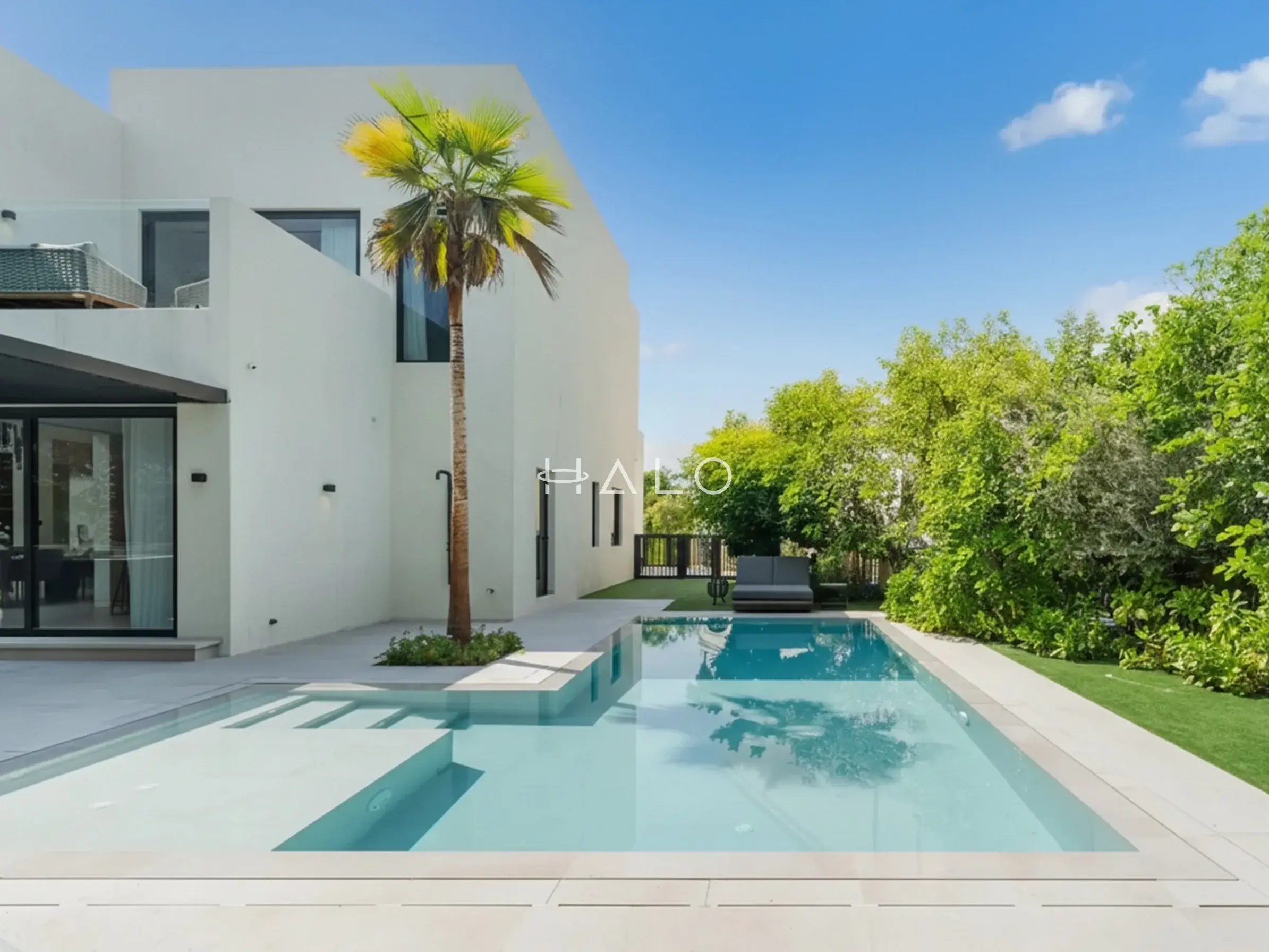
A swimming pool in Dubai is a waterproofed structure holding several tonnes of water in ground that shifts, with a plant room that has to work through 45°C summers. Most of what determines whether it lasts is buried before the first tile goes on: ground conditions, shell construction, tanking, and the drainage around it.
This guide covers what pool construction and renovation in Dubai actually involves, stage by stage — excavation, shell, waterproofing, plant and filtration, decks and coping, approvals and safety requirements — and where projects typically go wrong.
Start Your Pool Project With Halo
A swimming pool in Dubai is not a plumbing job bolted onto the back of a landscaping contract. It is a structural, mechanical and regulatory project that must be sequenced correctly from the first day of design, or it will cost significantly more to correct later. Ground conditions, drainage, MEP routing, filtration plant positioning and authority approvals are all interdependent; treat any one of them as an afterthought and you create a retrofit problem that no amount of remediation work fully resolves.
Since 1996, our team at Halo Interiors LLC has delivered over 1,200 projects across Dubai, including pools, landscaping, full villa renovations and complex MEP works. We are DM Approved and DEWA Certified, with in-house structural engineers, draftsmen, MEP specialists and a dedicated landscaping and pools division, all operating under one roof. That integration is what allows us to coordinate excavation, shell construction, filtration plant, deck works and authority submissions without the gaps that appear when separate contractors hand off to one another.
Browse our completed pool and property projects to see the range of work we deliver across Dubai villas and residential properties.
If you are planning a pool and want the approval process, MEP, structural works and landscaping handled without coordination risk, speak to our team directly or reach us on WhatsApp at +971 55 969 3009. The earlier we are involved, the more we can protect your programme and your budget.
Excavation and Ground Conditions in Dubai
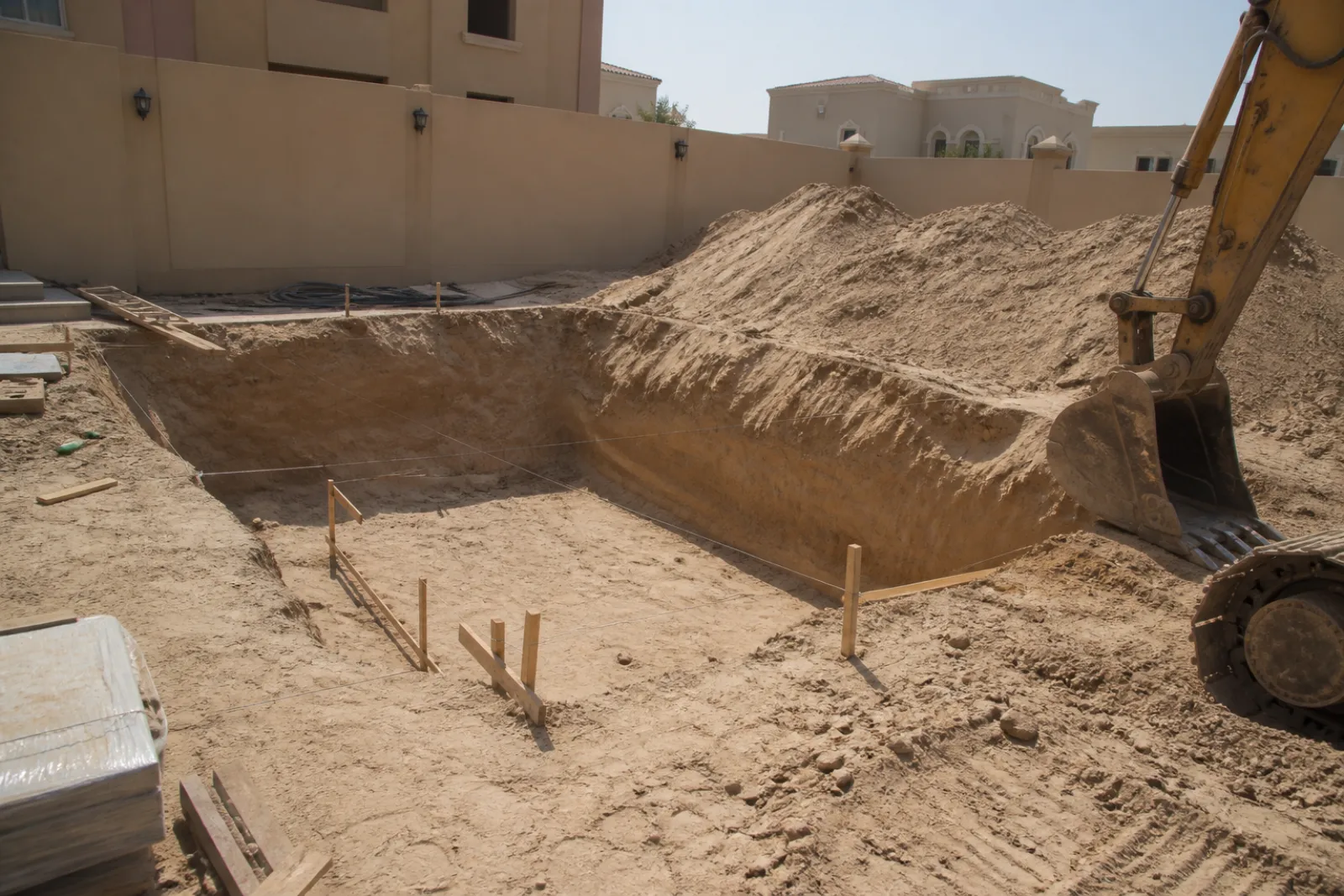
Dubai's ground is not uniform, and the difference between a plot in an inland villa community and one close to the coast can determine the entire structural specification of a pool shell. Compacted sand and gravel substrates allow for relatively straightforward excavation, while coastal and near-channel zones frequently contain sabkha, a salt-bearing soil that is expansive when wet, corrosive to steel reinforcement, and incompatible with standard waterproofing membranes. Where saline groundwater is also present, the threat to an underspecified shell is continuous rather than seasonal. Our structural engineers assess soil conditions at each site before any shell design is committed to drawings, because a specification written for the wrong ground type will fail regardless of how well it is built.
Ground bearing capacity is the first determinant of shell thickness and rebar density. Where bearing tests return weak or inconsistent results, additional base preparation is required, typically lean concrete blinding laid across the excavated formation to create a stable, level substrate before reinforcement begins. Skipping this step to save programme days creates differential settlement risk that no waterproofing layer can compensate for later.
The pre-excavation survey phase is equally non-negotiable. Dubai villa plots carry drainage runs, irrigation mainlines, and underground MEP services whose as-built positions frequently differ from original drawings. Our team commissions a full underground services survey before any machine breaks ground. Conflicts discovered mid-excavation require temporary shoring, service diversions, and authority notifications; the cost of resolving them at that stage is considerably higher than identifying them beforehand.
Shell Construction: What Goes Into the Structure
Once the excavation is signed off and ground conditions have been addressed, the shell becomes the single most consequential decision on the project. It is the permanent structural envelope of the pool, and that word "permanent" carries real weight: once the shell is backfilled and surrounding hardscape is laid, any structural defect discovered later is not a repair job. It is a demolition and rebuild exercise, with all the cost and programme disruption that entails. Our structural engineers treat shell specification as a zero-compromise stage.
Reinforced Concrete: The Method That Suits Dubai's Luxury Market
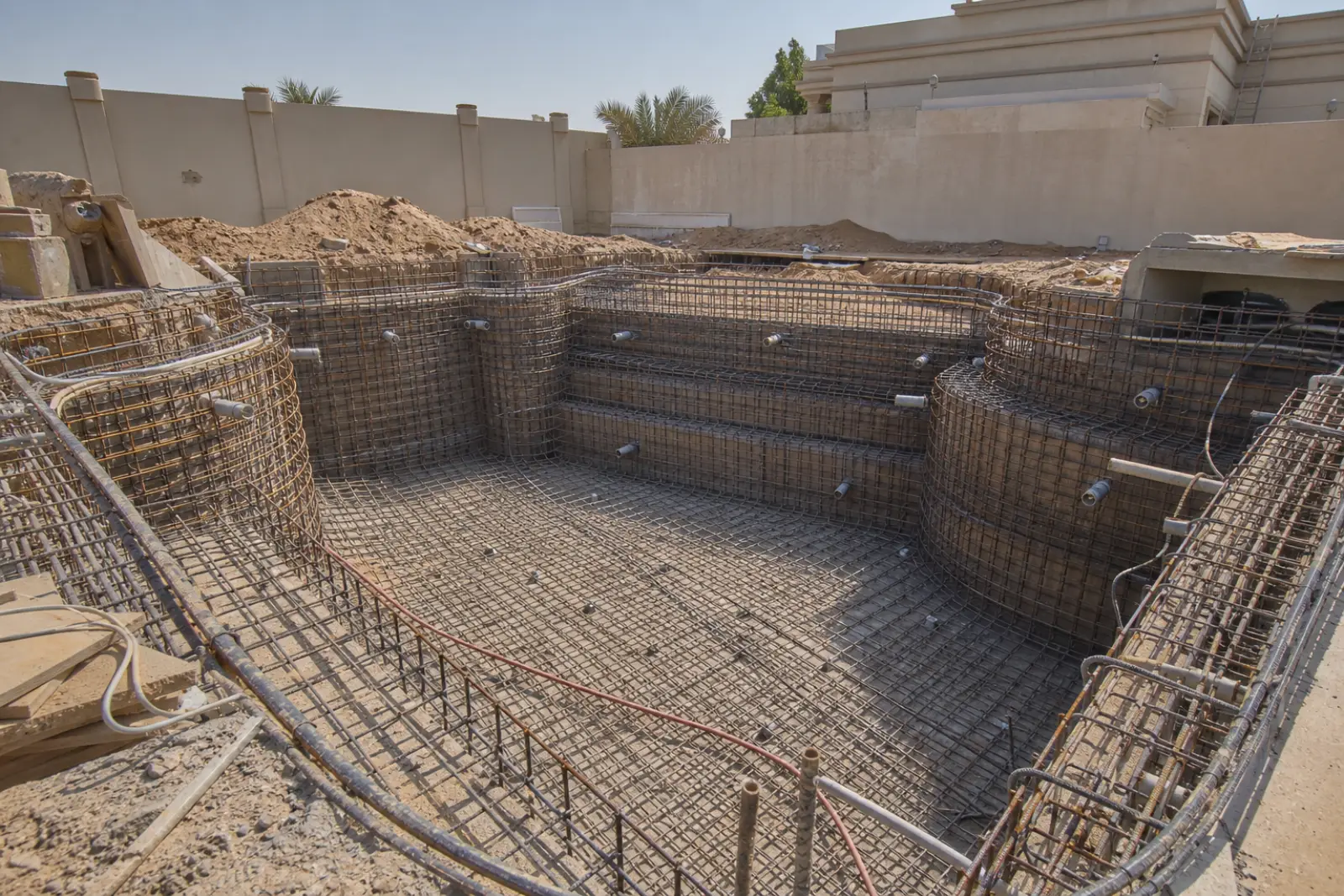
Gunite and shotcrete application onto a steel rebar framework is the dominant shell construction method for custom villa pools in Dubai. Both are pneumatically applied concrete processes; gunite uses a dry mix hydrated at the nozzle, while shotcrete arrives pre-mixed as a wet batch. In practice, both methods produce a dense, high-strength shell that can follow virtually any geometry, which is why they are the method of choice wherever freeform designs, infinity edges, or integrated spa shells are specified. A pre-formed fibreglass shell cannot achieve the same spatial freedom, and that matters when the design intent is a bespoke negative-edge pool aligned to a terrace axis.
Rebar, Mix Specification and Thermal Cycling
Before any concrete is applied, the rebar cage is installed, inspected, and signed off. Correct spacing and adequate concrete cover over the steel govern two separate outcomes: tensile strength under hydrostatic load, and long-term corrosion resistance in a saline environment. Both matter in Dubai. The concrete mix specification then determines how the shell performs through thermal cycling, because the temperature differential between a Dubai midsummer pool deck and a January night is substantial. Concrete that is insufficiently specified for that expansion range will develop hairline cracks at predictable locations, particularly at re-entrant corners and return walls. Our team specifies mix design and pour sequencing to account for these conditions from the outset, not as an afterthought.
Bond Beams and the Waterline Detail
Bond beams at the waterline are a structural element that receives less attention than it deserves. They must be correctly formed to carry the coping load above and simultaneously resist the lateral pressure of compacted backfill acting against the outer shell wall. A poorly formed bond beam is one of the more common causes of coping movement and cracking at the tile-to-coping joint, typically manifesting two or three seasons after handover when the real load conditions have cycled through.
Curing as a Non-Negotiable Hold Point
Shell curing must be completed fully before any interior finish is applied. Tile, pebble finish, or render bonded to an insufficiently cured shell will delaminate; the question is not whether, but when. Our site programme builds in the curing period as a hard hold point, not a flexible buffer to be compressed when other trades are pushing for access. Rushing this transition is one of the most preventable causes of surface failure on an otherwise competently built pool.
Waterproofing and Tanking: What Failure Actually Looks Like
Pool waterproofing works in two directions simultaneously. The membrane must prevent pool water from migrating outward into the concrete substrate, and it must resist saline groundwater pushing inward through the shell from outside. In Dubai, where the water table in coastal and low-lying areas carries high chloride concentrations, that inward pressure is not theoretical. Chloride-laden moisture attacking unprotected steel reinforcement is a slow process, but by the time it becomes visible, the structural damage is already advanced.
How Failure Presents
Failure follows a recognisable sequence. Efflorescence, the white salt deposits that appear on tile surfaces or along grout lines, is the earliest visible signal. It indicates active moisture movement through the substrate, not a surface staining problem. Left unaddressed, the same moisture migration begins to undermine tile adhesion; the bond between tile and substrate weakens, grout fails, and tiles debond. At that stage, the repair scope has expanded from a membrane issue to a full strip-and-reline operation. In the worst cases, water passing through the shell reaches adjacent below-grade structures: plant rooms, basement slabs, or foundation elements. By the time staining or damp patches appear on those surfaces, water has already been working through the concrete for some time.
Specification Is Not One-Size-Fits-All
Cementitious systems, crystalline admixtures, and liquid-applied membranes each perform differently depending on substrate type, water table conditions, and the finish material going over them. A crystalline admixture suits a dense gunite shell in moderate ground conditions; a flexible liquid-applied membrane is better suited to a shell subject to thermal cycling, which is a real consideration in Dubai where surface temperatures move between winter and peak summer extremes. Applying the wrong system to the right shell, or the right system incorrectly, produces the same failure sequence. The specification decision requires an assessment of ground conditions, shell construction method, and finish, not a default to whichever product is available on site.
The Accountability Gap
The most common reason waterproofing fails on fragmented builds is not product failure; it is the absence of a single accountable party overseeing application sequence, thickness, curing, and junction detailing. When the waterproofing trade is subcontracted separately from the shell contractor, responsibility for the interface between those two scopes belongs to no one. Our Halo Shield waterproofing system is applied by our own team, not subcontracted. That single fact changes how a defect is handled: there is no dispute about which trade applied the membrane, and no gap in the chain of custody between shell construction and waterproofing application.
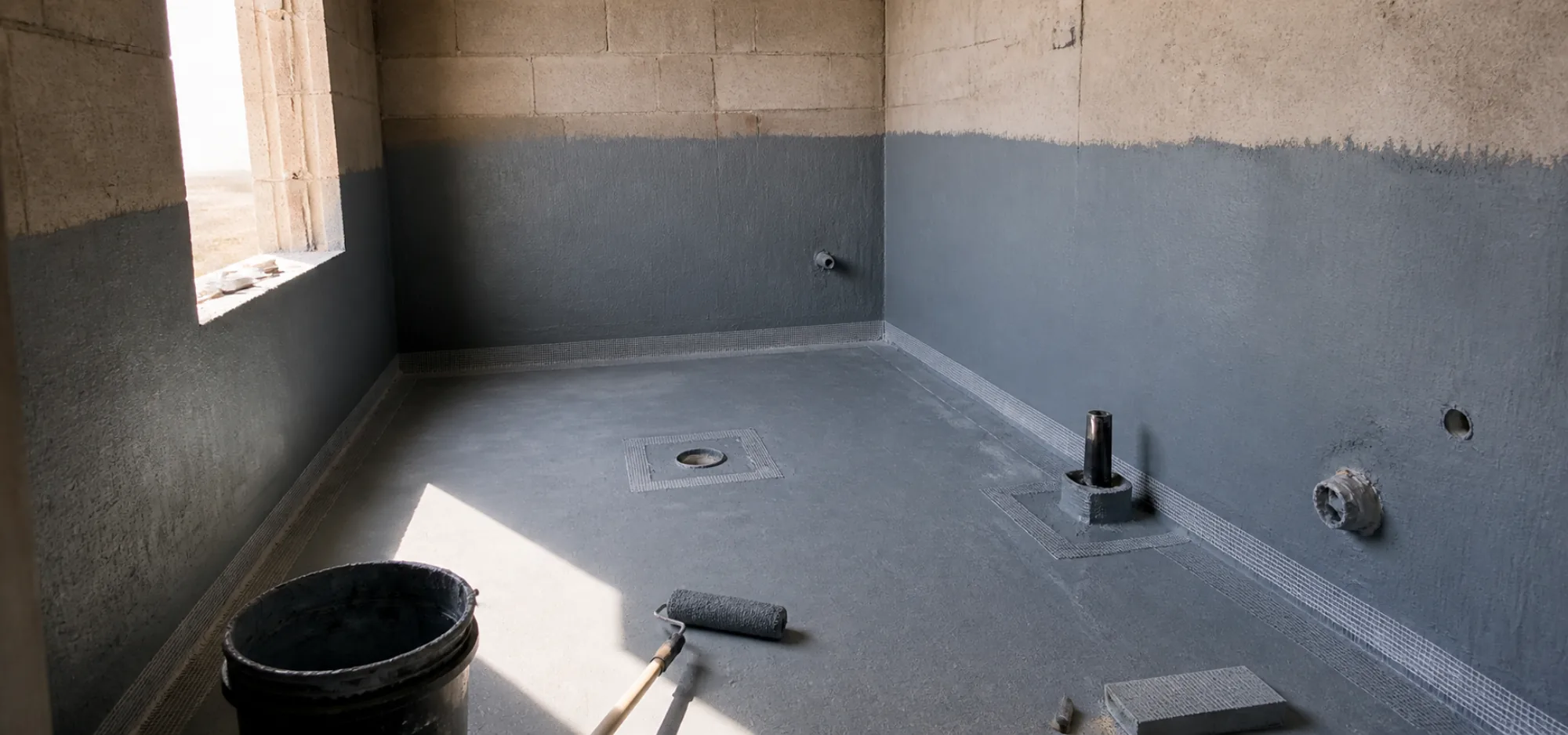
The same specification applied to the pool shell must extend to the plant room and any below-grade equipment voids. This area is consistently underspecified on builds where trades are fragmented, because no single contractor owns both scopes. A plant room wall that is inadequately tanked will admit the same saline groundwater that the pool shell is designed to exclude.
Plant, Filtration, and Temperature Control for Dubai's Climate
Dubai's climate imposes demands on pool water temperature at both ends of the calendar. Through the summer months, surface water left unmanaged can climb well beyond comfortable swimming temperature, making an active chiller a functional requirement rather than a luxury. Through the cooler winter months, an unheated pool becomes unusable for much of the day. A properly specified pool in Dubai carries both a chiller and a heat exchanger, sized together to cover the full seasonal range.
The plant room is where all of this is controlled, and its specification is a design-stage decision with long-term consequences. It houses the pump, filtration media, chemical dosing equipment, and the thermal management unit. Undersizing it is one of the most common cost-reduction moves on early project budgets, and it consistently produces the same outcomes: overworked pumps, compromised water clarity, restricted access for routine maintenance, and shortened equipment life across every component in the room. Our MEP and HVAC team designs the plant room as an integrated mechanical space, not as an afterthought, with correct clearances, drainage, and ventilation specified before excavation begins. Retrofitting any of these elements after the shell is complete is disruptive and significantly more expensive than building them in from the start.
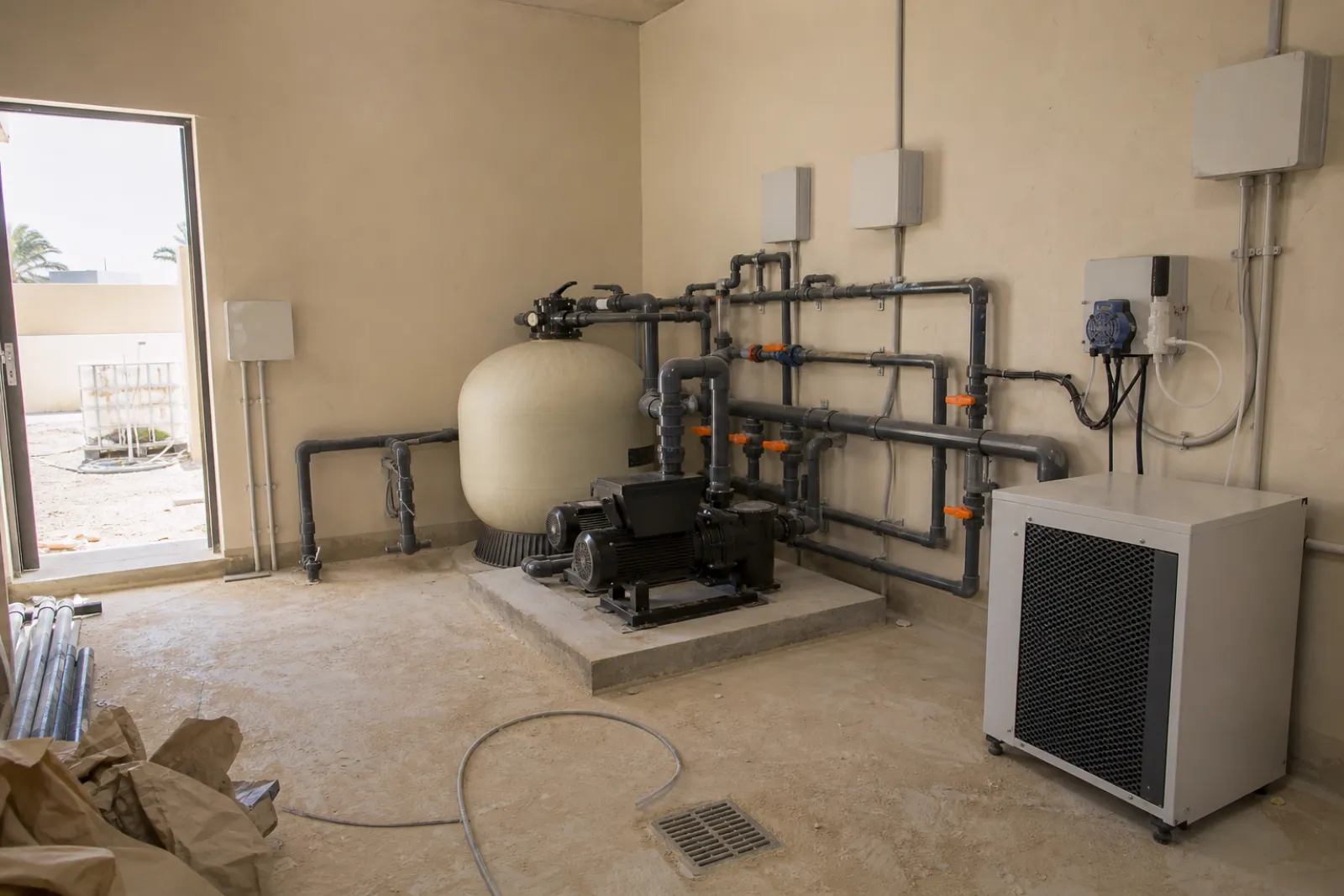
Filtration performance is governed by the circulation turnover rate: how frequently the total pool volume passes through the filtration system. This figure must be matched to the pool's volume and expected bather load during design. It cannot be meaningfully adjusted after commissioning without changing the pump specification, so getting it right at the outset is the only practical approach.
Variable-speed pump technology is now the correct specification for any serious Dubai pool project. It draws considerably less energy than single-speed alternatives under normal operating conditions, which matters both for running costs and for alignment with Dubai's broader sustainability agenda. Smart pool automation builds on this: remote temperature control, automated chemical dosing, and filtration scheduling are increasingly standard on villa projects in Dubai, and they integrate cleanly with wider home automation systems for centralised property management.
Pool Decks, Coping, and Outdoor Integration
The pool deck and coping are where every structural, chemical, and thermal force on the project converges into a single surface. Foot traffic, poolside furniture, chemical splash from chlorination and salt systems, UV exposure, and the thermal cycling between Dubai's summer heat and cooler winter nights all act on this zone simultaneously. Expansion joints between coping units and between the coping and the deck field are not optional detailing; without them, thermal movement will open cracks that channel water directly toward the shell edge and sub-base.
Coping Material Selection
Porcelain, natural stone, and reconstituted limestone are the materials we specify most consistently on Dubai villa projects. All three offer the slip resistance and chemical durability the environment demands. Colour and tone matter beyond aesthetics: lighter materials reflect a meaningful proportion of solar radiation rather than storing it as surface heat, which makes barefoot use tolerable through the summer. Dark stone or timber-composite decking can reach surface temperatures that are genuinely uncomfortable mid-afternoon, regardless of how well it is installed. Material selection is therefore a comfort engineering decision as much as a finish choice.
Drainage Gradients and Trade Sequencing
Deck falls must direct surface water away from the pool shell and away from adjacent planting beds and building foundations, routing it toward dedicated drainage channels. Getting this wrong is one of the more common causes of moisture ingress at foundation level and die-back in soft landscaping on Dubai villa projects. The gradient is set during sub-base preparation, not corrected at tile level, which is why it must be engineered before any finish layer goes down.
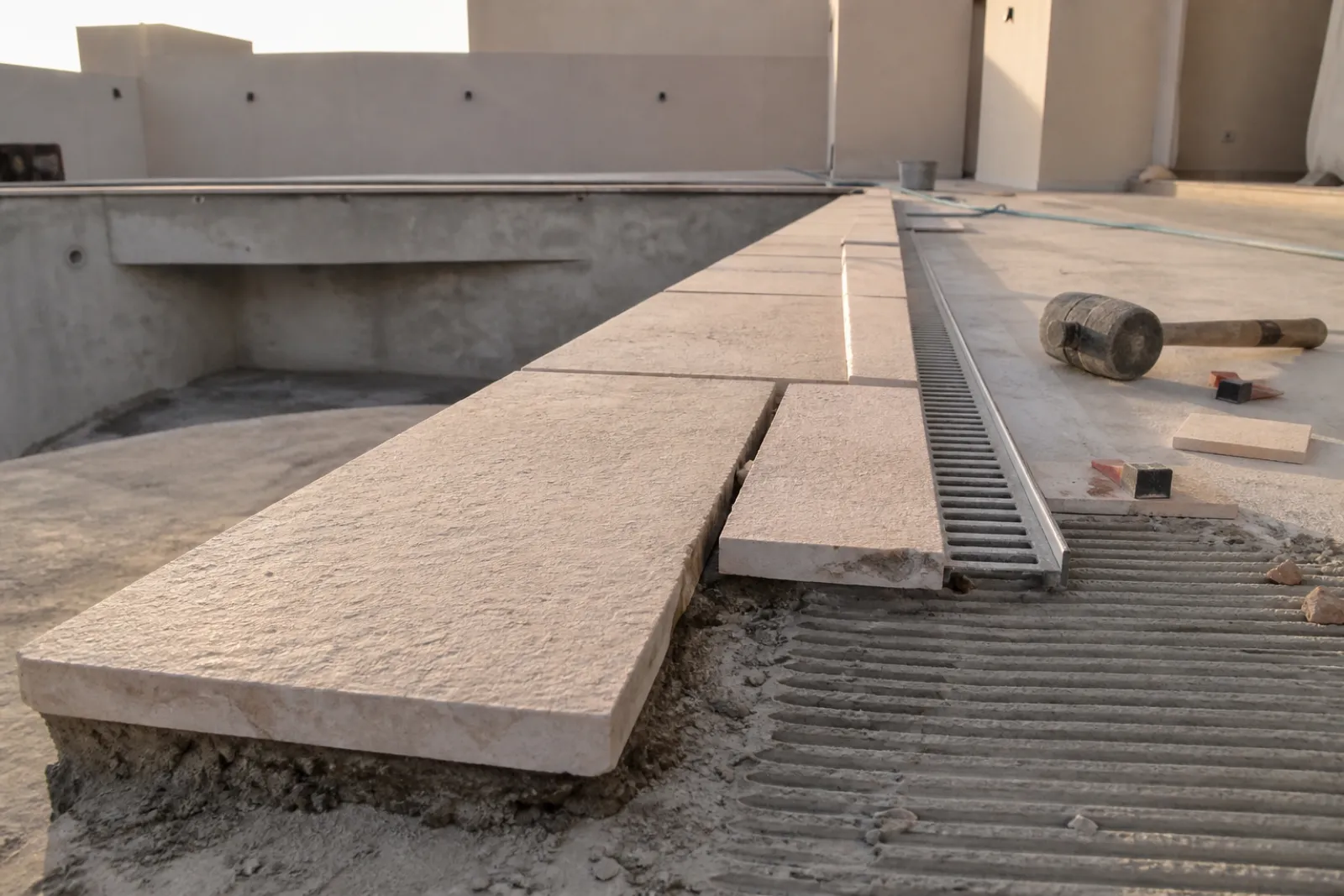
Sequencing is where projects managed across separate contracts most often create problems. Irrigation lines, outdoor lighting conduits, drainage runs, and any sub-deck cabling must be installed, tested, and signed off before decking is laid. If those trades follow the pool contractor independently rather than running concurrently under a coordinated programme, the result is breakout through finished surfaces and reinstatement costs that could have been avoided entirely. Our landscaping and pools team works within the same project programme as our MEP and civil trades, so underground services are never a retrofit.
Completing the Outdoor Scope
Pergolas, shade structures, outdoor kitchens, and feature lighting are now routinely specified as part of the same villa project rather than deferred to a separate contract. Coordinating gas, water, and electrical connections to an outdoor kitchen with the pool shell and deck installation requires the same sequencing discipline as the drainage and irrigation runs beneath the deck. Our outdoor living and landscaping capability covers the full scope, from pool shell to finished pergola, as a single coordinated transformation rather than a sequence of separate engagements.
DM Approvals, Safety Requirements, and Community Rules
Every swimming pool on a Dubai property requires Dubai Municipality approval before a single cubic metre of earth is moved. The DM Technical Guidelines for Swimming Pool Plan Approval set out the full submission requirements, and construction without that approval exposes the owner to stop-work orders and the potential mandatory demolition of any unapproved structure. The approval process involves an initial application, a site inspection, and a post-construction inspection, meaning DM is engaged at multiple stages rather than once at the outset.
For properties within master-developed communities, there is an additional gate before DM submission can proceed. The relevant community management body or master developer must issue a no-objection certificate for external works first. The NOC process and the DM process run sequentially, not simultaneously, and each can take several weeks. Clients who do not account for this two-stage dependency enter the project with unrealistic timeline expectations, and our team flags this at the earliest planning conversation.
Our authority approvals service handles both gates in-house. As a DM Approved contractor, we prepare and submit the full documentation package, including structural drawings, MEP schematics, cross-sections, plumbing and electrical layouts, and waterproofing specifications, without the owner needing to separately engage a consultant. In-house engineers and draftsmen produce these documents as part of the design process, not as an additional external cost that arrives after contract signature.
Safety fencing is a formal part of the approval framework. Community management bodies frequently impose fence height, permissible material, and gate-latch specifications that go beyond the DM baseline, particularly on properties where children are present. Clients should obtain the community-specific fencing standards from their HOA or developer before finalising any deck or boundary design.
Electrical connections for pool plant equipment, lighting, and heating systems require DEWA certification. Our DEWA Certified team manages this as part of the MEP scope rather than as a separate engagement, which removes a common coordination gap between civil completion and electrical commissioning.
Stage-by-Stage Timeline and Why Sequencing Matters
The single most common cause of programme overrun on a Dubai pool project is not weather, labour, or material supply. It is treating the pool as a plug-in trade that can be slotted into a landscape build at any convenient point. Every stage creates a hard dependency for the next, and our project managers enforce that sequence without exception.
| Stage | What Happens | Key Dependency |
|---|---|---|
| 1. Authority approvals and NOC | DM drawings submission, community NOC, developer consent | Nothing moves until approvals are issued |
| 2. Excavation and groundworks | Dig, dewatering if required, soil removal | Approved drawings in hand |
| 3. Shell construction and curing | Rebar, formwork, gunite or shotcrete application | Excavation signed off; MEP rough-in already placed |
| 4. MEP rough-in | All pipework, conduits, and drainage in position | Must be completed before backfill; omitting this forces re-excavation |
| 5. Waterproofing and tanking | Membrane application and full cure | Shell structurally stable; no tile adhesive until curing is complete |
| 6. Interior finish | Tile, render, or pebble application | Waterproofing cured to specification |
| 7. Plant room fit-out and commissioning | Pumps, filters, chiller or heater, automation | Interior finish complete; DEWA connection confirmed |
| 8. Deck, coping, and landscaping | Hard landscaping, coping installation, planting | Shell stable, backfill settled; premature decking cracks within the first season |
| 9. Water fill, chemical balance, and handover | Fill, chemistry startup, client walkthrough | All plant commissioned and tested |
Two dependencies carry the most risk on site. First, all pipework and conduits must be in position before shell backfill. If this is missed, the only remedy is re-excavation, which disrupts the surrounding landscape and resets the programme by several weeks. Second, waterproofing membranes must reach their full specified cure before any tile adhesive is applied. In Dubai's summer heat, surface membranes can appear dry within hours, but that is moisture loss, not cure. Applying adhesive over an incompletely cured membrane is the primary cause of tile delamination within the first year.
Deck and landscaping works follow the same logic. Until the shell has reached structural stability and backfill settlement has occurred, any hard landscaping placed around the perimeter is at risk of differential movement. Decking laid prematurely will show differential cracking within the first season, and the only remedy is full re-laying.
The indicative programme from approved drawings to water-ready runs from several weeks to a few months, depending on pool size, finish specification, and approval lead times. Our landscaping and pools team issues a specific programme at tender stage with each stage gated, so there are no ambiguous handover points between trades. For a detailed discussion of how we sequence your project, contact our team or reach us on WhatsApp at +971 55 969 3009.
Water Treatment and Ongoing Maintenance Load
A Dubai pool operates every month of the year, which means every month of the year requires active management. There is no winter shutdown, no dormant period, and no quiet season during which a backlog of deferred servicing can be absorbed. If a filter backwash cycle is skipped or a chemical rebalance delayed, the consequences accumulate immediately rather than waiting until spring.
Water chemistry is the most demanding ongoing variable. pH balance, sanitiser levels, total dissolved solids, and calcium hardness all require regular testing and adjustment. Dubai's mains water supply, though desalinated, carries elevated mineral content. As evaporation concentrates those minerals in the pool water over time, calcium hardness climbs and scale begins to form on tile surfaces, pipework, and the internal components of heat exchangers and chillers. Left unmanaged, this scale degrades both the visual finish and the rated efficiency of mechanical plant, accelerating wear across the entire system.
Evaporation compounds the chemistry problem. Dubai's summer ambient temperatures drive high surface water loss from open pools, and each top-up from the mains supply introduces a fresh mineral load. A properly sized auto-fill valve maintains consistent water levels without manual intervention, and a pool cover or integrated shade structure directly reduces evaporative loss, cutting both water consumption and the volume of chemicals required to maintain balance.
Filter media requires periodic backwashing to maintain flow rates and water clarity, and eventual replacement when the media itself degrades beyond cleaning. Heat exchangers and chillers are mechanical assets whose efficiency deteriorates silently if annual servicing is skipped; fouled surfaces and refrigerant issues can drive up energy consumption well before a component failure becomes visible.
At handover, our team provides the owner or their facilities manager with a documented maintenance schedule and a water chemistry baseline specific to that pool's volume, surface finish, and plant configuration. This is part of the handover package. It gives any subsequent service team a verified starting point rather than requiring them to diagnose the pool's chemistry from scratch, and it is the difference between proactive management and reactive repair.
Plan Your Pool Project With Halo
We are DM Approved and DEWA Certified, with in-house structural engineers, an MEP division, and our Halo Shield waterproofing system operating under a single contract. That integration is what separates a pool that performs for decades from one that develops cracks, leaks, or circulation failures within a few years of handover.
Thirty years of delivery in Dubai, 1,200+ completed projects, and a 4.9 Google rating are the measurable record behind that claim. Our landscaping and pools division works alongside our MEP, waterproofing, and authority approvals teams from day one, so nothing is subcontracted out and no accountability gap opens between trades.
Frequently Asked Questions
Do I need Dubai Municipality approval to build a pool on my villa plot?
Yes. Pool construction is classified as an external structural work and requires DM approval before any excavation begins. Dubai Municipality's swimming pool approval requirements set out the documentation needed, including site plans, structural cross-sections, and filtration and drainage details. If your property sits within a master-developed community, you will also need a developer NOC before DM submission can proceed. We manage both stages as part of our authority approvals service.
How long does a pool project take from start to finish in Dubai?
Programme length depends on pool size, finish specification, ground conditions, and how quickly approvals are obtained. The approval and NOC stage alone can take several weeks, and that clock starts before any physical works begin. Our project managers issue a specific programme at tender stage once the design and site conditions are confirmed, so you have a realistic schedule rather than a generic estimate.
What is the difference between pool waterproofing and standard construction waterproofing?
Pool waterproofing must resist continuous hydrostatic pressure from both directions simultaneously. The membrane works outward against the water body and inward against saline groundwater and soil moisture pressing through the shell. Standard construction membranes are not rated for this dual-direction load, and applying them to a pool shell is a specification error that typically presents as damp migration, substrate degradation, or finish failure within a short time. The correct specification depends on shell type and the specific ground conditions on your plot. Our Halo Shield waterproofing system is specified accordingly for each project.
Do I need a pool heater and a chiller in Dubai?
For year-round use, yes. Surface water temperatures in summer can climb well beyond comfortable swimming temperature without active chilling. In winter, particularly from December through February, water temperatures drop enough to make an unheated pool uncomfortable for regular use. A combined heat pump or separate chiller and heater unit is standard specification on Dubai villa pools. The plant must also be sized correctly relative to pool volume and sun exposure; undersized equipment will run continuously without reaching target temperature.
Why should pool construction be coordinated with landscaping rather than done separately?
Irrigation pipework, drainage channels, outdoor lighting conduits, and deck sub-base preparation all need to be installed before pool backfill and deck laying. If these trades are run as separate contracts, each one requires breaking out completed work to install what was missed, adding cost and extending the programme significantly. Our landscaping and pools division and MEP team operate under a single contract and a single programme, which is the only way to guarantee that sequencing holds. Treating the pool as a standalone trade is the most common reason Dubai pool projects run over time and over budget.