Landscaping in Dubai fails below ground before it fails above it. Salinity in the soil, drainage that has nowhere to go, and irrigation sized for a temperate climate account for most of the planting that dies in its second summer — and none of it is visible when the job is handed over.
This guide covers what landscape work on a Dubai property actually involves: what sits beneath the planting, how irrigation and drainage are designed for these conditions, what community approvals apply to external works, and realistic timelines.
What Landscape Work on a Dubai Property Actually Covers
Landscape work on a Dubai villa encompasses far more than planting a few palms and laying some paving. The full scope divides into two primary categories: softscape and hardscape. Softscape covers all living elements, including lawns, trees, shrubs, flowerbeds, and ground cover planting selected for the Gulf climate. Hardscape covers every built element: stone pathways, tiled patios, kerbing, decorative walls, steps, and entrance portals. Beyond these two foundations, a complete outdoor project typically includes swimming pools and water features, custom pergolas and shade structures, outdoor lighting circuits, and a fully engineered irrigation network. Each of these elements involves sub-surface infrastructure, and that is the point most villa owners underestimate at the planning stage.
Treating landscaping as a cosmetic layer applied after construction is one of the most reliable ways to create expensive problems. Pool shells require structural engineering input before the slab is poured. Pergola footings must be detailed in coordination with terrace waterproofing membranes; penetrate that membrane without proper specification and you introduce water ingress directly into the structure below. Outdoor lighting requires conduit and power distribution runs that belong on MEP drawings, not on a wish list after handover. Irrigation mainlines need to be coordinated with civil drainage so that root-zone moisture does not accumulate against foundations. These are construction decisions, not finishing decisions, and they must be resolved at design stage alongside every other trade on the project.
This is precisely why our landscaping and pools service is structured as part of a single turnkey contract rather than a separate engagement bolted on at the end. Our in-house MEP team, structural engineers, and landscape specialists work from the same drawing set from day one. Irrigation, drainage, pool engineering, lighting power supply, and waterproofing beneath planted areas are all coordinated internally before a single level is broken on site. That integration eliminates the coordination gaps that arise when these trades are split across separate contractors.
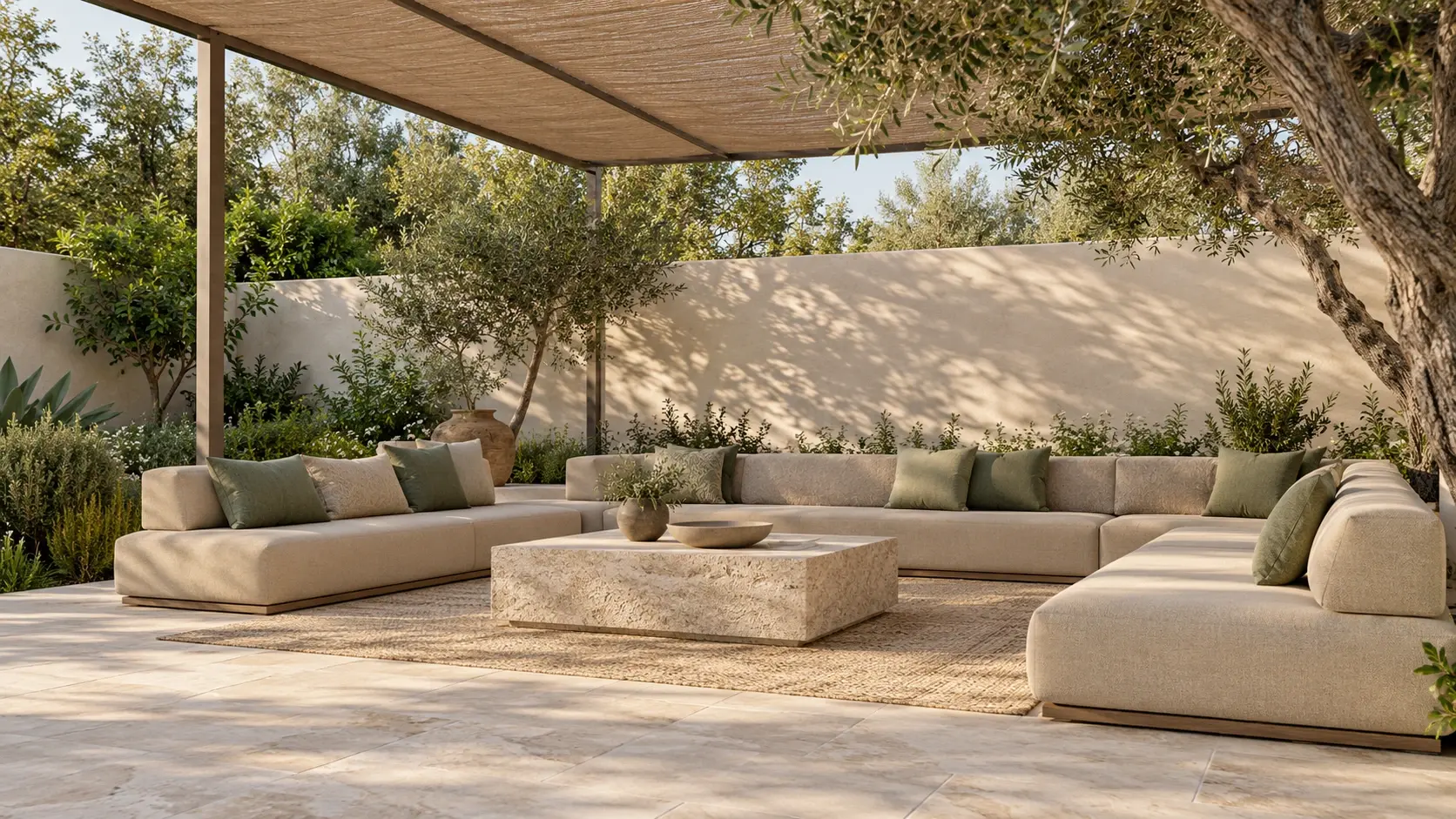
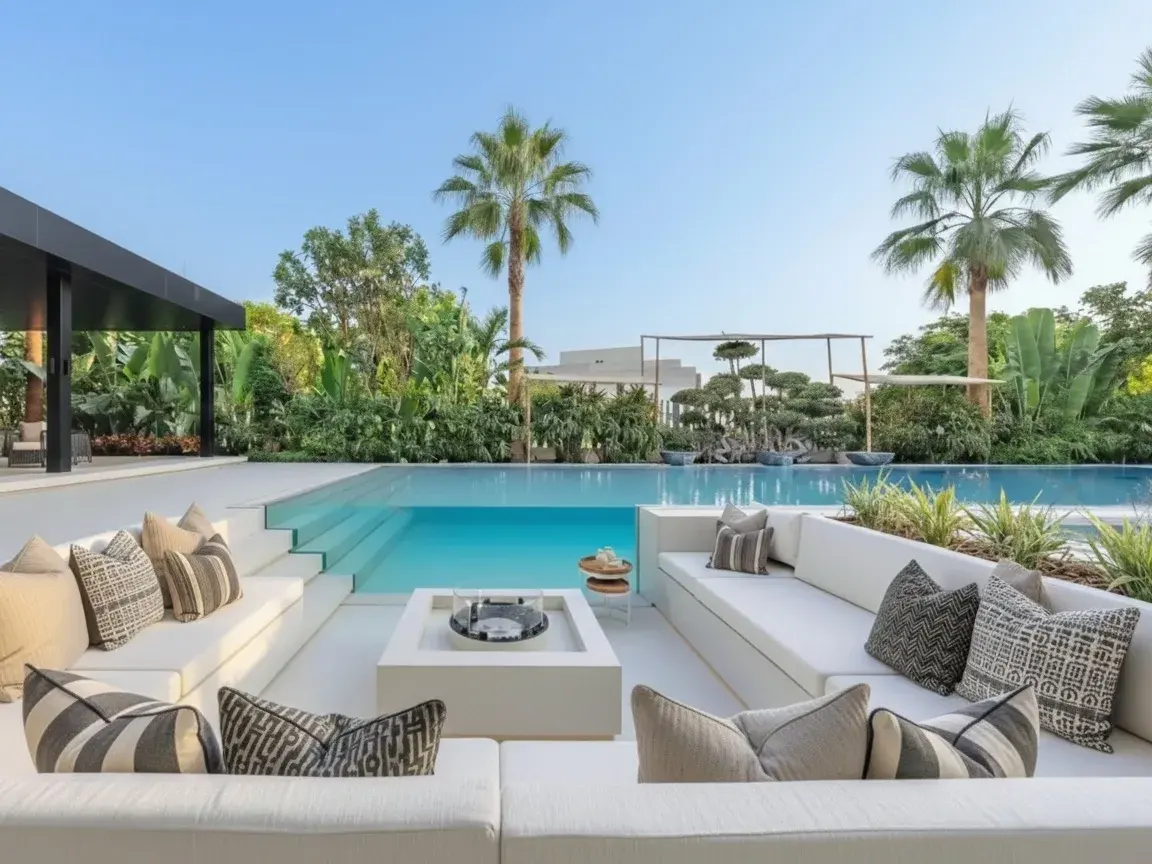
Dubai villa owners increasingly regard the garden, pool terrace, and shaded outdoor lounge as liveable rooms, continuous with the interior rather than separate from it. The residential projects we execute reflect that expectation consistently: the outdoor specification is developed in parallel with the interior fit-out, not as an afterthought. If you are at the early scoping stage for a villa project, contact our team or reach us on WhatsApp at +971 55 969 3009 to discuss scope before contractor appointments are made.
Soil, Salinity and What Lies Beneath the Planting
Dubai's native ground is predominantly sandy, saline, and alkaline. These are not incidental inconveniences; they are the baseline conditions that determine whether a planting scheme thrives or quietly deteriorates before the first summer is over. Sandy soils drain so rapidly that water passes below the root zone before young roots can access it. Alkalinity locks up iron and manganese, producing the yellowing of new growth that is frequently misread as underwatering. Salinity concentrates at the root zone under repeated irrigation cycles, drawing moisture away from roots through osmotic pressure rather than delivering it. As practitioners working across Dubai villas and podium terraces, we see the consequences of ignoring this baseline on a regular basis.
Soil Replacement and Amendment
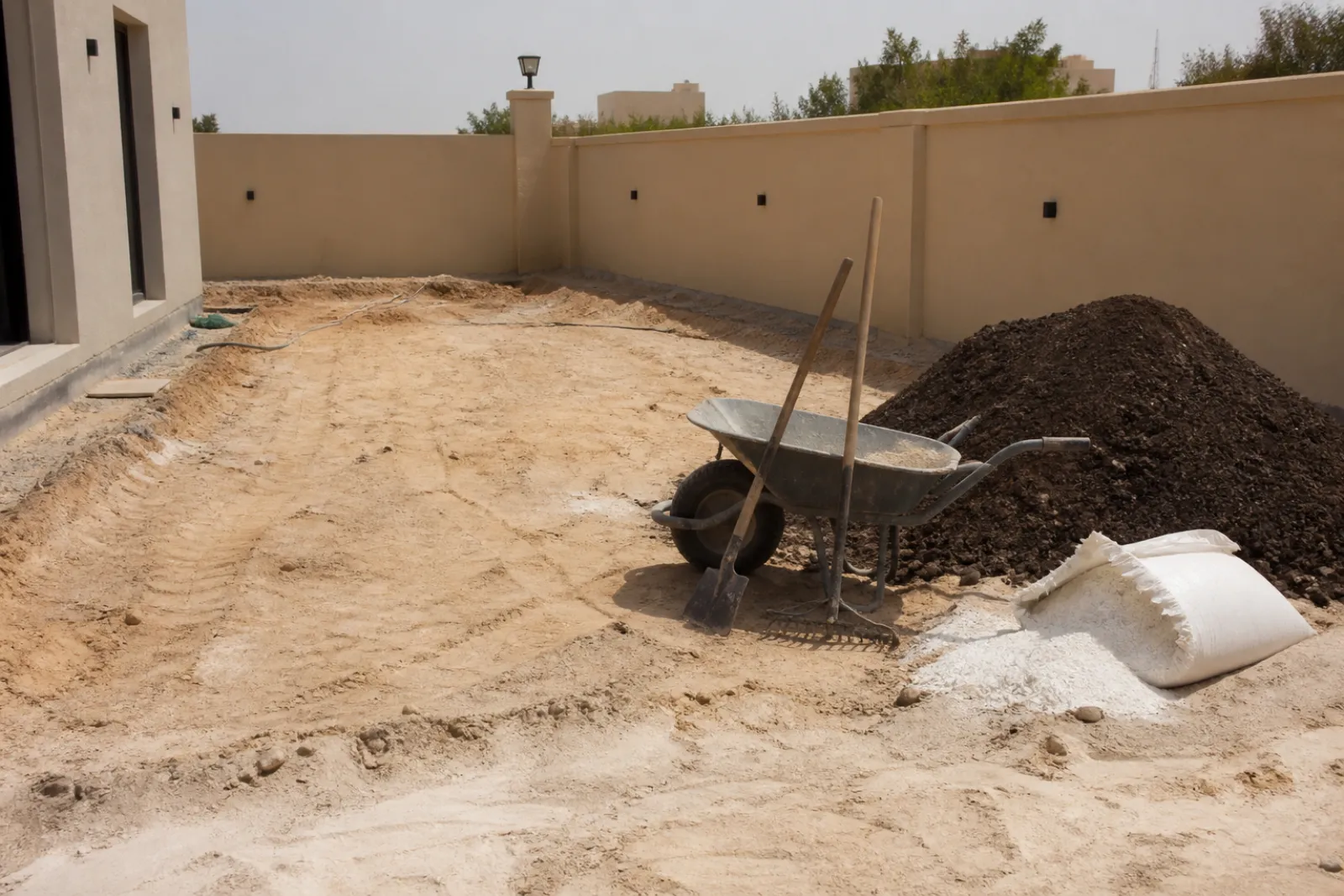
No planting programme should begin without addressing what the roots will actually grow into. The standard approach involves replacing or substantially amending native sand with imported topsoil and real organic matter, correcting pH before species go in the ground, and specifying amendments by planted zone rather than applying a blanket note across the entire scheme. On reclaimed or heavily saline ground, gypsum application displaces sodium from soil particles and restores both water movement and root oxygenation. A critical and frequently overlooked requirement is the leaching fraction: irrigation design must apply slightly more water than plants consume so that salts are continuously flushed downward past the root zone rather than accumulating within it. Token amendment in an oversized pit, without addressing drainage below it, is money discarded. A granular drainage layer or sump beneath feature trees and low-lying beds prevents the bathtub effect, where a planting pit fills with retained water and drowns roots between irrigation cycles while appearing, from the surface, to be drought-stressed.
Salinity as an MEP-Adjacent Problem
Soil salinity is not solely a horticultural concern. Saline groundwater and irrigation runoff attack paving mortar joints, accelerate corrosion in PVC and HDPE drainage pipes, and degrade the sheathing on buried electrical conduit. This is why our MEP engineers are involved in ground preparation decisions, not just in the installation of irrigation lines and outdoor power circuits. When soil treatment is deferred or abbreviated, the consequences extend to infrastructure that is expensive to repair and disruptive to access once paving is laid over it. Treating soil preparation as a preliminary horticulture task, separate from MEP and civil works, is one of the structural errors our team routinely inherits when brought in to remediate a failed scheme.
Root Barriers and Structural Separation
On rooftop gardens, podium decks, and elevated planters, the planted bed sits directly above a waterproofing membrane and a structural slab. Root barriers, typically HDPE sheet membrane, and non-woven filter geotextiles are not optional in these locations. Root barriers prevent aggressive root systems from penetrating and rupturing the waterproofing layer beneath. Geotextile filter layers separate the growing medium from the drainage aggregate below it, preventing fine soil particles from migrating into drainage channels and blocking them over time. Omitting either element voids the waterproofing warranty and creates a repair scenario that requires full removal of the planted bed, drainage layer, and growing medium before the membrane can be accessed. Our waterproofing and building protection work always accounts for what will be planted above it, because the two cannot be designed in isolation.
Skipping proper ground preparation is the primary reason planted areas fail within the first Dubai summer. The plant is replaced; the ground is not corrected; the replacement fails again. Quality of preparation below the surface determines long-term performance above it, and no amount of premium planting stock compensates for a deficient substrate.
Irrigation Design and Water Management in Dubai
Every outdoor water supply point on a Dubai property requires a connection to either DEWA-supplied potable water or a Treated Sewage Effluent (TSE) network, depending on the property type and the infrastructure available within your community. These are not interchangeable, and the decision is not yours to make unilaterally; it is determined by your community's infrastructure and confirmed during the authority approval stage. Our DEWA-certified status means our team can navigate this process directly, preparing the technical submissions required before any outdoor supply line is installed.
System Types: Matching the Method to the Function
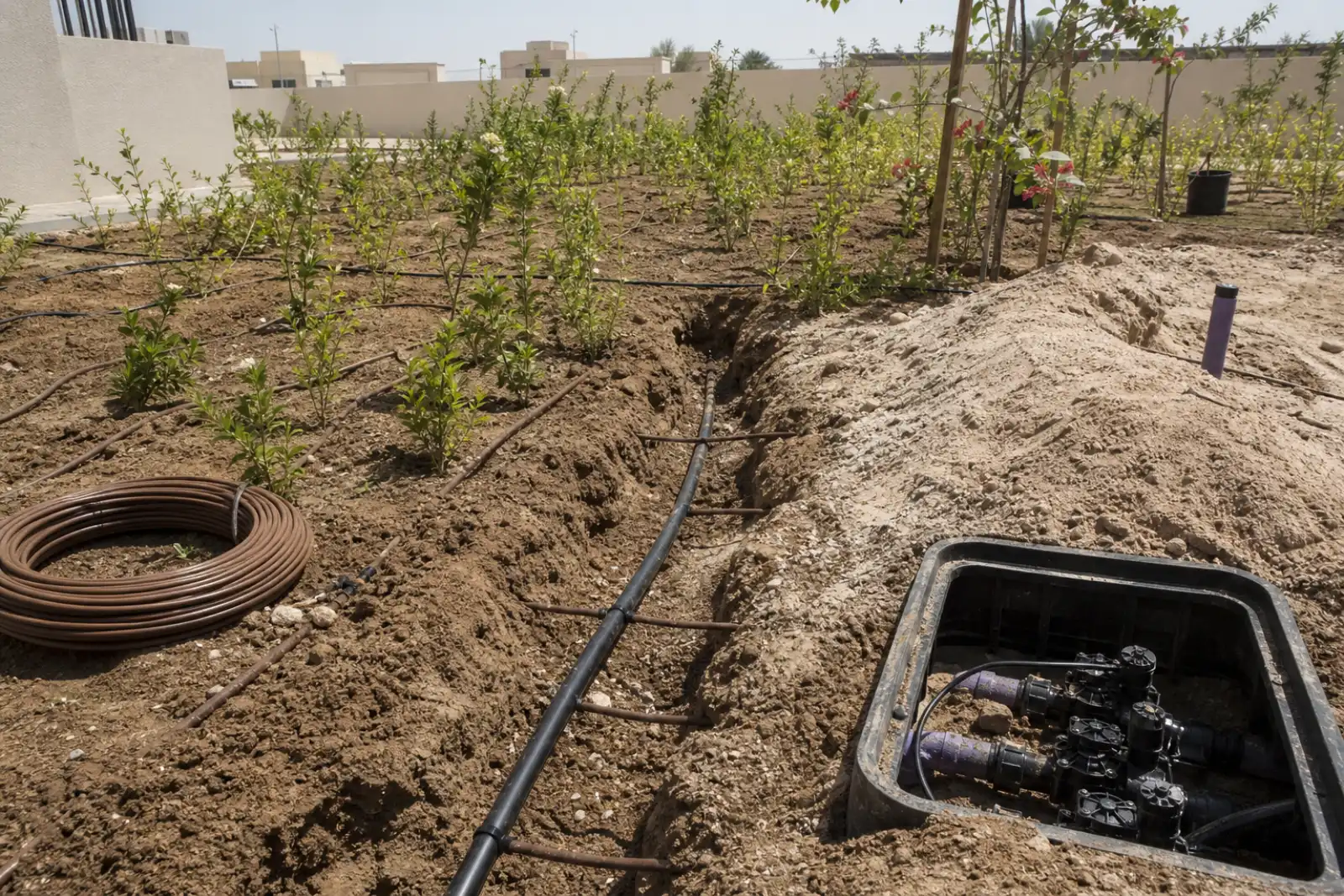
A properly designed irrigation scheme is never a single-system solution. Drip irrigation serves planted beds, delivering water directly to root zones through a network of emitters and sub-surface tubing. It minimises surface evaporation, which matters considerably when summer temperatures regularly exceed 45°C, and it allows water delivery to be calibrated individually by plant species and bed size. Pop-up sprinkler systems are appropriate for turf areas; they retract flush with the surface when not in use and distribute water across a broader footprint. Micro-misting serves a different function entirely, providing evaporative cooling in shaded outdoor areas such as covered terraces and pergola seating zones, where reducing the ambient temperature is the objective rather than hydrating a root system. All three must be designed as a single coordinated network from the outset, with separate pressure zones, independent valves, and a unified control architecture.
Controllers, Scheduling and Automation
Scheduling is where the majority of water waste either occurs or is prevented. Watering cycles must be programmed for early morning, before solar gain drives evaporation rates to their peak. Smart irrigation controllers take this further by integrating soil moisture sensors that prevent the system from running when the ground already holds adequate moisture. Our team regularly integrates these controllers with home automation platforms and building management systems, so irrigation can be monitored and adjusted remotely alongside other building services. This is particularly valuable for property investors who are not in residence year-round.
Authority Approvals and DEWA Connection Requirements
Before any outdoor supply line is connected, the design must be submitted for authority approval. DEWA requires that outdoor water supply points include compliant metering and backflow prevention devices to protect the potable network from contamination. These are not optional add-ons; they are conditions of connection approval. Our authority approvals team manages this submission process in-house, which removes one of the most common sources of delay on landscape projects.
Over-Irrigation and Waterlogging
In Dubai's saline, sandy soil, over-irrigation is as damaging as drought. When water accumulates around root zones without adequate drainage, the combination of waterlogging and salt concentration accelerates root rot. The soil's low natural permeability compounds this; water that cannot drain laterally sits at root level and creates anaerobic conditions in which most planted species cannot survive. Irrigation design must therefore be developed in conjunction with the drainage and sub-base design described in the previous section, not after it. Emitter flow rates, cycle duration, and run-off gradients must all be calculated together to ensure that water reaches root zones without pooling. Our landscaping and pools team treats irrigation and drainage as a single engineering problem, not two separate scopes.
Drainage, Slab Waterproofing and Why It Must Come First
Drainage and waterproofing beneath planted areas are not finishing-stage considerations. They are foundational works that must be designed, specified, and installed before a single paver is laid or a root ball goes into the ground. Retrofitting either system after hardscaping and planting are complete requires full demolition of the completed works, which is both costly and disruptive to any occupied or partially occupied property. Grading and drainage engineering is a prerequisite discipline, not an afterthought.
The Layered Build-Up Beneath a Planted Slab
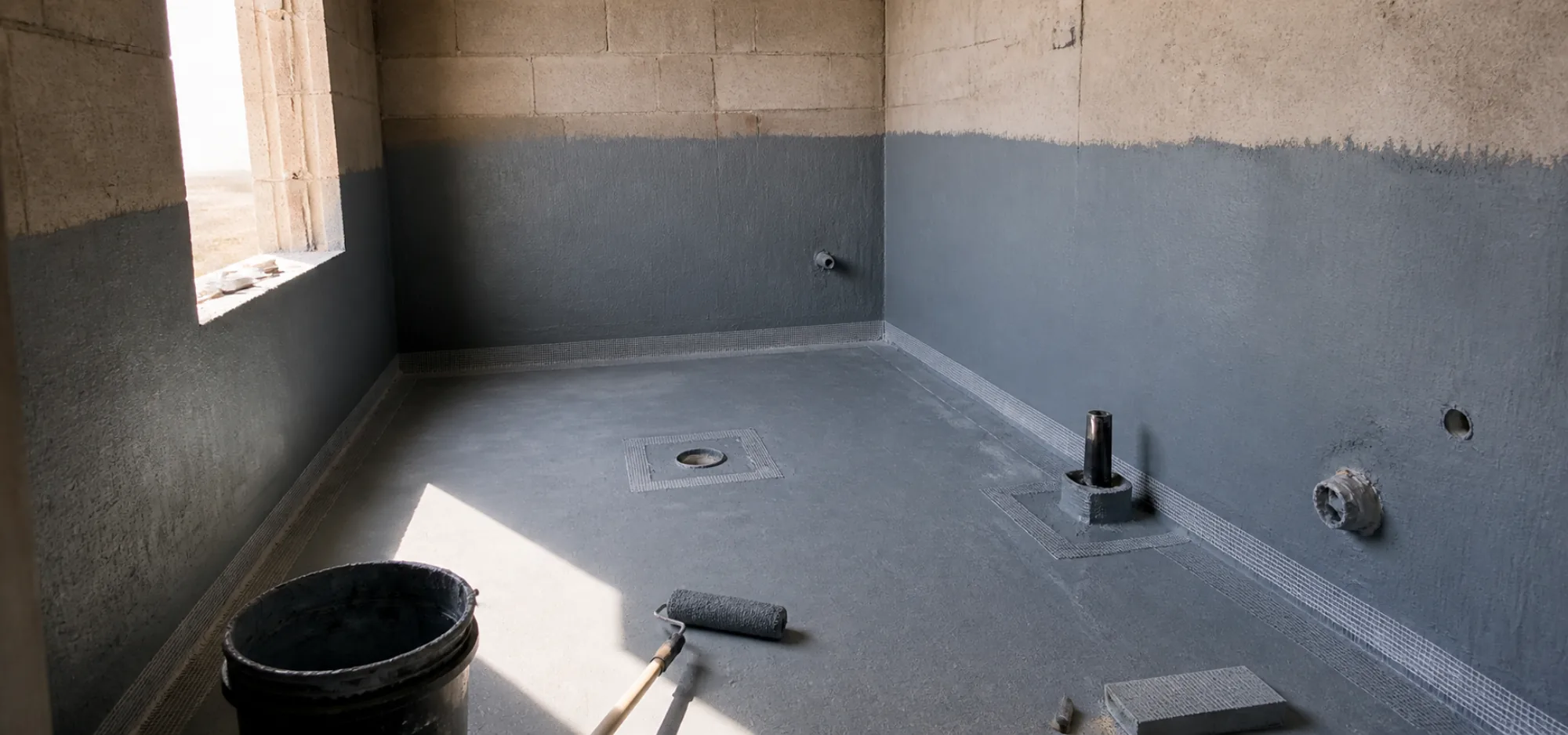
Where a planted area sits above a concrete structure, the substrate assembly follows a defined sequence. The waterproofing membrane forms the primary barrier against water infiltration into the slab and any habitable space below. A protection board sits directly above the membrane, shielding it from mechanical damage during subsequent construction activity. Above that, a drainage cell provides the void space through which excess irrigation water and rainfall travel laterally to outlet points, preventing hydrostatic pressure from building against the membrane. A filter fabric layer above the drainage cell stops fine particles from the growing medium migrating downward and blocking the drainage voids. The growing medium itself sits at the top: an engineered substrate, not general fill, specified both for plant health and for the structural slab's load rating. Each layer has a discrete function; omitting or substituting any one of them compromises the performance of the others.
What Happens When Waterproofing Fails
Inadequate slab waterproofing produces consequences that compound over time. Water infiltrating into habitable spaces below a planted deck is notoriously difficult to trace and repair once the landscape build-up is in place; finding the breach typically means demolishing the surface works entirely. Sustained moisture penetration initiates carbonation and chloride-induced corrosion of reinforcement steel, progressively weakening the slab's structural capacity. It also creates an accountability problem: in standard Dubai practice, defects liability coverage is contractually set at 12 months for finishes and significantly longer for structural elements, but that coverage is routinely contested where waterproofing can be shown to have been absent, sub-standard, or installed out of sequence. The commercial case for getting this right first time is straightforward.
Our specialist waterproofing system, Halo Shield, is specifically designed for the demanding conditions that planted decks create: sustained irrigation moisture, root-penetration risk, extreme thermal cycling, and UV exposure. Outdoor planted areas above concrete slabs are one of the most common applications we deliver under this system.
Why Subcontracting This Trade Creates Risk
Landscape contractors without in-house waterproofing capability must procure a separate sub-contractor for the membrane works. This introduces coordination gaps at the interface between the waterproofing scope and the landscape build-up above it, and fragments accountability when a failure occurs. Each party points to the other's work as the origin of the problem, and the client carries the cost and delay while liability is established. Our turnkey model places a single point of responsibility over the entire substrate-to-surface assembly, from the membrane up to the finished planting.
Surface drainage must be engineered with the same rigour. The required falls across paving, channel drains positioned at the base of planters, and the confirmed connection to the site's storm drain network must all be specified before ground is broken. As with the membrane system, resolving drainage problems after construction is reliably more complex and expensive than specifying them correctly at the outset.
Species Selection, Hardscaping, and Shade Structures
Dubai's outdoor climate does not negotiate. Sustained summer temperatures, intense UV exposure, and the desiccating effect of dry desert air mean that every species placed in the ground must be selected on technical merit, not purely on appearance. A plant that performs beautifully in a temperate European garden will typically fail within a single Dubai summer if it lacks the physiological tolerance for heat stress, high soil alkalinity, and irregular water availability. We treat species selection as a structural decision, made at the design stage and coordinated with irrigation zoning and shade planning before procurement begins.
Plant Categories That Perform in Dubai Conditions
Four functional categories anchor every planting scheme we design. Native palms and Phoenix species, including the date palm, form the vertical structure of most Dubai gardens; they are deeply adapted to the regional climate and require comparatively modest irrigation once established. Drought-tolerant shrubs, including bougainvillea and hardy ornamental grasses, provide colour and density with low water demand. Succulent and xeriscape ground covers reduce bare soil exposure, suppress surface temperature, and require minimal maintenance in open, sun-exposed areas. For covered zones beneath pergolas or shade sails, shade-tolerant understory plants can be specified where direct sun exposure is reduced, broadening the palette available to the designer without compromising plant health.
Hardscaping: Material Selection and What Sits Beneath It
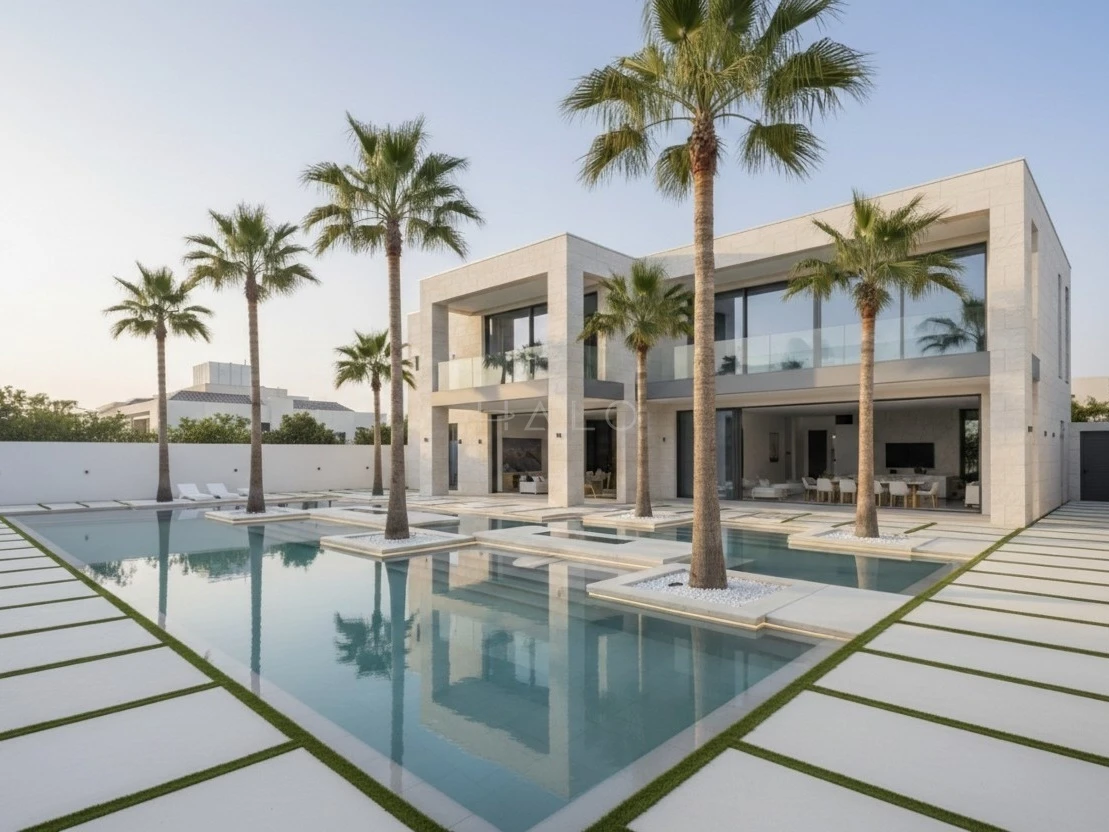
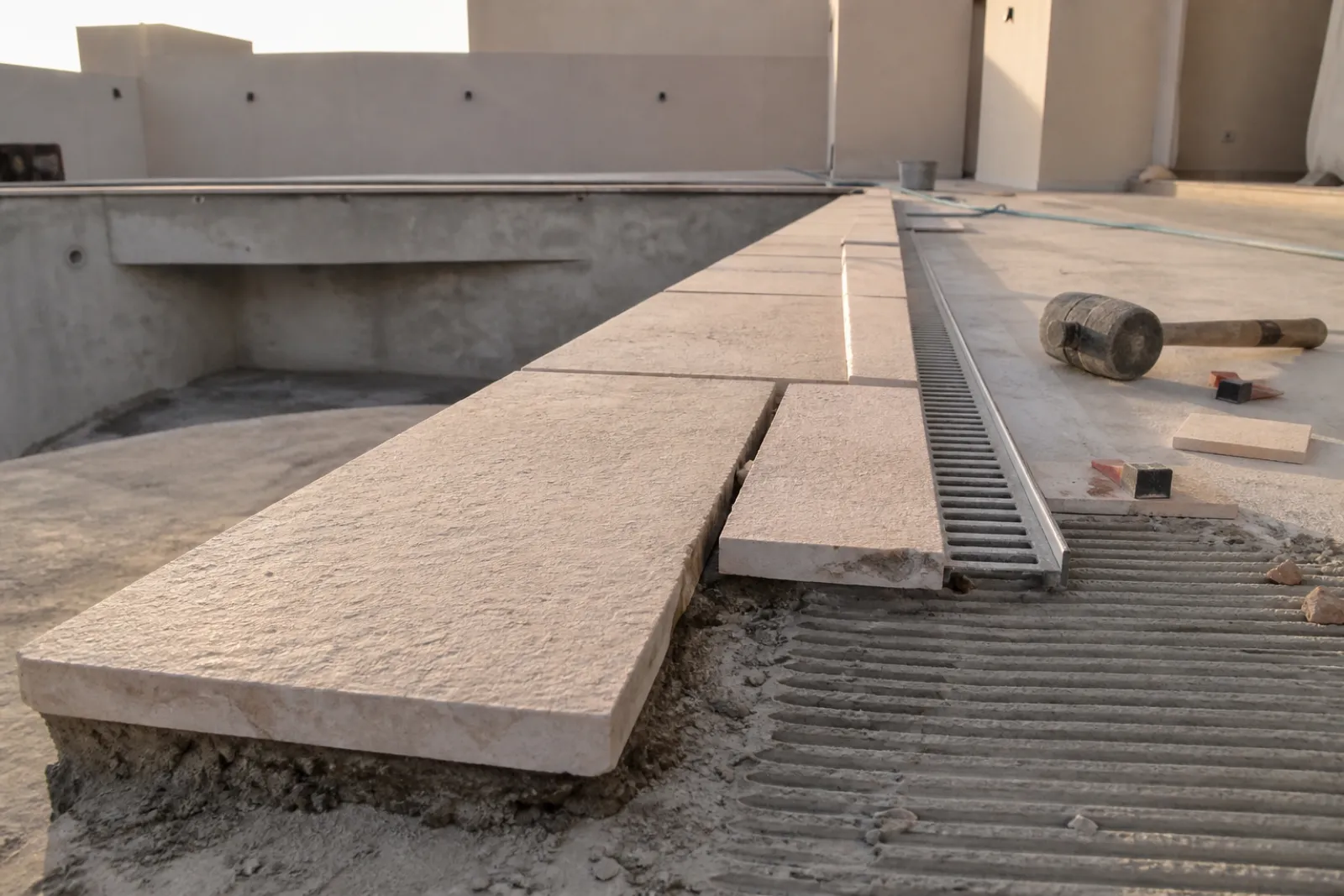
Paving material selection in Dubai carries technical implications that go beyond aesthetics. Porcelain, natural stone, and concrete unit paving all behave differently under thermal cycling; expansion joints must be sized and positioned to accommodate the temperature differential between cooler months and peak summer surface temperatures. Slip resistance is a non-negotiable specification criterion wherever paving is adjacent to pools, water features, or irrigation runoff zones. Critically, the drainage falls and sub-base design discussed in the previous section must already be fixed before any surface material is selected; the paving must follow the drainage geometry, not the other way around.
Shade Structures, Lighting, and Regulatory Requirements
Pergolas, louvred roof systems, and shade sails are among the most requested additions to Dubai villa gardens, and for good reason: covered outdoor zones extend usable living hours considerably. However, any fixed or semi-permanent shade structure within a gated community requires a structural engineering sign-off and a community NOC from the relevant master developer's community management authority before installation can proceed. Skipping that approval sequence creates liability and can result in a demolition notice.
Outdoor lighting and power require the same level of advance planning. Landscape lighting circuits must be specified during the MEP design stage, with conduit routes and draw points agreed and sleeved before any paving is laid. All exterior fittings must carry appropriate IP ratings for outdoor and wet-zone use, and supply arrangements must comply with DEWA requirements. Retrofitting electrical conduit beneath finished hardscape is one of the more avoidable costs we see on projects where lighting was treated as an afterthought.
Our approach to outdoor living spaces treats the garden, terrace, and shade zone as a continuous extension of the interior brief, coordinated under the same design and delivery structure from the outset.
Community Approvals and Authority Requirements
External works on any Dubai villa or residential property sit within a layered approvals framework, and the sequence matters as much as the paperwork itself. Before a single paver is laid, a shade structure is erected, or a boundary treatment is altered, the property owner requires a No Objection Certificate from the relevant community management body or master developer. This applies across gated villa communities throughout Dubai, where community management organisations hold formal authority over any change to a plot's external appearance. Submitting that NOC application early is not optional; community review boards operate on set schedules, and approval timelines can extend across several weeks.
Dubai Municipality issues a separate category of NOC covering works that may affect cultivated public areas, drainage networks, and irrigation infrastructure. Structural additions, including pergolas with permanent footings, retaining walls, and hardscaping that interacts with the plot's civil structure, all fall under DM jurisdiction. Because we are DM-approved, our applications carry a track record the authority recognises, which supports smoother processing. DM's NOC service for landscaping-related works also encompasses outdoor paving for buildings and entrances and groundwater drainage, making it directly relevant to any substantive outdoor project.
DEWA's requirements add a further layer. Any new outdoor electrical connection, supply extension, or sub-metering arrangement for irrigation systems or pool equipment requires a formal DEWA application before work commences. NOCs for construction projects that may affect drainage and irrigation networks must be obtained to prevent destruction of those networks, a principle that applies equally to DEWA's utility infrastructure. As a DEWA-certified contractor, our team is authorised to carry out this work directly; non-certified parties cannot legally execute these connections.
Starting landscaping work before approvals are in place exposes the property owner to stop-work orders and the cost of reinstating any non-compliant works. Our authority approvals service manages the full submissions process, covering DM, DEWA, and community NOC applications, as an integrated part of the turnkey contract rather than an afterthought.
Maintenance Load After Handover
A Dubai landscape does not enter a low-maintenance phase after handover. The climate ensures that irrigation systems, planted areas, and hardscaping all require consistent, structured attention from the first week of occupation. Irrigation controllers need seasonal reprogramming as temperatures shift between summer and winter, emitter flow rates require checking as mineral deposits accumulate in the lines, and plants need feeding and pruning on schedules that account for Dubai's compressed growing window. Hardscaping is not passive either; paving joints require periodic sand replenishment and resealing to prevent water ingress and surface movement over time.
The Defects Liability Period
In standard Dubai practice, a 12-month defects liability period is contractually set at handover. During this period, the contractor is responsible for remedying any failures attributable to workmanship or materials. For landscaping, this covers irrigation system faults, drainage failures, plant losses linked to installation error, and structural movement in paved surfaces. The defects period is not a maintenance contract; it is a workmanship warranty. It does not cover deterioration caused by the owner's failure to maintain the landscape to the agreed programme. That distinction matters, and both parties should be clear on it before the handover certificate is signed.
The Structured Maintenance Programme
The maintenance programme agreed at handover should address four areas without gap. Irrigation scheduling must be set by season, with summer frequencies adjusted for peak evapotranspiration demand and winter schedules reduced accordingly. Fertilisation cycles should be specified for each species group, given that Dubai's alkaline soils require pH-corrected feeding regimes to prevent nutrient lock-out. Pest and disease inspection is particularly important during the humid summer months, when fungal issues can establish rapidly in dense planting. Paving joint maintenance, including sand replenishment and surface cleaning, should be scheduled at least twice annually to prevent joint erosion and weed ingress.
Pool Surrounds and the Risk of Split Contracts
Where a landscaped pool surround forms part of the project, the maintenance programme for the planted and paved areas should run under the same contract as the pool itself. Splitting these responsibilities between two separate providers creates a gap at the interface between water and planted areas. Defects at the coping edge, drainage channel, or waterline planting beds can fall between two providers' scopes, with each attributing responsibility to the other. A single maintenance programme eliminates that ambiguity.
The maintenance burden after handover is not independent of the design decisions made months earlier. Species that require frequent irrigation, fertilisation, or replacement in Dubai conditions carry a higher long-term cost than climate-adapted alternatives. Irrigation system quality, hardscape material durability, and drainage design all influence how much time and cost the property owner commits to the landscape each year. Our team at Halo factors maintenance load into every landscaping and pools project we deliver, because the decisions made at design stage are the ones the owner lives with longest.
Stage-by-Stage: A Typical Dubai Landscape Project
The sequence below reflects how our team structures a typical Dubai landscape project from first site visit to client handover. Indicative durations are drawn from our delivery experience across more than 1,200 projects; actual programmes vary by site complexity, property size, and authority response times.
| Stage | Key Activities | Indicative Duration | Sequencing |
|---|---|---|---|
| 1. Survey and Soil Assessment | Site topography, soil and drainage analysis, utility marking | 3–5 days | Must precede design |
| 2. Design and Specification | Concept drawings, material schedules, irrigation and lighting layout | 2–4 weeks | Runs parallel to early approval preparation |
| 3. Authority Approvals | DM submission, DEWA application, community NOC | Several weeks; most variable stage | Critical path; least controllable |
| 4. Ground Preparation and Waterproofing | Excavation, grading, subbase, waterproofing membranes on slabs and podiums | 1–2 weeks | Sequential after approvals |
| 5. MEP First Fix | Irrigation pipework, electrical conduit, lighting cabling buried or concealed | 1–2 weeks | Can partially overlap with ground preparation |
| 6. Hardscaping and Drainage | Paving, decking, pergola bases, retaining walls, drainage channels and sumps | 2–4 weeks | Sequential after first fix |
| 7. Planting and Turf | Trees, shrubs, groundcovers, turf laying | 1–2 weeks | Sequential after hardscaping; timing sensitive to season |
| 8. Lighting and Irrigation Second Fix | Fixture installation, controller connection, drip and spray head fitting | 3–5 days | Runs parallel to planting |
| 9. Commissioning and Snagging | System testing, irrigation scheduling, lighting programming, defect rectification | 1–2 weeks | Sequential; all trades complete |
| 10. Handover | Client walkthrough, documentation pack, maintenance schedule | 1–2 days | Final stage |
The approvals stage carries the most programme risk. DM and DEWA submissions depend entirely on third-party response times, and community NOCs from master developers add a further layer that no contractor can expedite unilaterally. Our approvals team manages submissions proactively and in parallel with design refinement, which compresses the total programme without cutting corners on compliance. You can see how we handle this across our full authority approvals service.
Not every stage is strictly sequential. Design development and early approvals preparation run concurrently. MEP first fix overlaps with the tail end of ground preparation. Lighting and irrigation second fix proceeds alongside planting. Managing those parallel tracks competently requires a single coordinated programme, not separate contractors each running their own schedule. When trades are split across multiple firms, interface disputes multiply: a hardscaping contractor finishing late delays the planting team, who delays irrigation commissioning, and in Dubai's climate a missed seasonal window can push practical completion by months.
The same logic applies when villa renovation and landscaping run under one contract. Structural works from a renovation contractor and irrigation trenching from a separate landscape contractor create direct physical conflicts on site. Electrical conduit routes planned indoors can clash with outdoor lighting cabling laid independently. Under a single contract with one programme, those conflicts are resolved at the drawing stage rather than on site at cost. Our landscaping and pools division operates within that same integrated structure, coordinating directly with our in-house MEP team from the first fix through to commissioning.
Frequently Asked Questions
Do I need Dubai Municipality approval for landscaping work on my villa plot?
Yes, if the work involves any structural element, DM approval is required. This includes pergolas, boundary walls, retaining structures, and permanent shade structures. Purely soft landscaping within the plot boundary may not require a DM permit, but it will almost always require a NOC from the community management before works begin. Our authority approvals team manages both layers as part of the project scope, so nothing moves to site without the correct sign-off in place.
Can my landscaping and pool be built at the same time as my interior renovation?
Yes, and running both under a single contract is the most efficient approach available to a Dubai villa owner. When separate contractors handle interior and exterior works independently, scheduling conflicts and interface disputes are common, particularly around waterproofing junctions, MEP routing, and access sequencing. Our team delivers interior fit-out, landscaping, and pool construction under one programme, with a single project manager coordinating the sequence from shell works through to final handover. You can review completed projects across both scopes in our project portfolio.
Which plants survive Dubai summers without constant intervention?
Species from the Phoenix palm family, bougainvillea, adenium, agave, and several ornamental grasses perform reliably in Dubai's climate when planted in correctly prepared soil with calibrated drip irrigation. The critical factor is not the species alone; it is the combination of species selection, soil amendment, and irrigation scheduling. A drought-tolerant plant placed in unamended sandy soil with poorly calibrated irrigation will still fail. Our landscape team makes all species decisions at design stage, matched to the specific microclimate, aspect, and soil conditions of each plot.
Why does waterproofing matter for a garden on a concrete slab?
Water retained in a planted bed on a concrete structure will find a path through any crack or imperfectly sealed joint over time. Without a properly installed membrane beneath the growing medium, that moisture reaches the slab and infiltrates the space below, which is typically a garage, basement, or habitable room. The damage is slow, largely invisible until it becomes serious, and expensive to remediate once finishes are in place. Our Halo Shield waterproofing service specifies and installs the correct membrane system before any growing medium or paving is laid, as part of the same coordinated programme as the landscape works above it.
What does the maintenance programme look like after a landscape is handed over?
A properly scoped maintenance programme covers seasonal irrigation adjustment, fertilisation, pruning, pest inspection, and paving care. The scope and frequency depend on the species planted, the overall size of the landscape, and whether a pool is included in the property. Dubai's summer conditions place the greatest stress on planted areas and irrigation equipment, so the programme must account for that peak period specifically. The maintenance scope should be agreed and priced before handover, not sourced separately afterwards. To discuss a full landscaping and outdoor living project including post-handover maintenance, contact our team or reach us on WhatsApp at +971 55 969 3009.
Scope Your Dubai Landscape Project with Halo
Halo Interiors LLC has been delivering property transformation projects in Dubai since 1996. With 1,200+ projects completed, a 4.9 Google rating, and DM-approved and DEWA-certified status, we bring verified credentials to every external works programme we undertake.
The practical advantage of working with us is consolidation. Landscaping, pools, interior fit-out, joinery, MEP, waterproofing, and authority approvals are delivered under one contract, one programme, and one point of accountability. There is no fragmentation across separate contractors, no coordination gap between the irrigation installer and the MEP team, and no ambiguity about who is responsible when disciplines overlap. Our in-house structural engineers, MEP specialists, and draftsmen work within the same programme as our landscape and pool crews, which is the only way to ensure that drainage, slab waterproofing, power, and planting are sequenced correctly from the outset.
For the full scope of what our landscaping and pools division delivers, visit our landscaping and pools service page.