Cabinet failure in Dubai is almost always a materials and sequencing problem, not a design problem. Swollen carcasses, delaminating edge bands, and seized drawer runners are not signs of a poorly designed kitchen; they are symptoms of the wrong specification for this climate.
Why Dubai Kitchens Fail Faster Than You Expect
When we strip back failed kitchens across the 1,200+ projects our team has delivered over 30 years, the pattern is consistent: boards that were never rated for sustained humidity exposure, edges left partially sealed, and hardware selected for temperate conditions rather than the thermal stress Dubai imposes every single day.
Dubai's environment is genuinely unusual in the stress it places on joinery. The city combines coastal humidity, particularly acute in waterfront locations, with year-round air-conditioning cycling that oscillates interior temperatures sharply against the extreme ambient heat outside. Wood-based boards are hygroscopic; they absorb and release moisture continuously in response to these shifts, placing every joint, adhesive bond, and surface film under repeated mechanical stress. Each cycle that goes unchecked by correct specification widens the gaps through which moisture then enters. Within a few years, kitchens that looked flawless at handover begin showing the consequences.
Sink and hob zones deteriorate first and fastest. The under-sink carcass contends with plumbing condensation, intermittent splashback, and the warm baseline temperatures that accelerate any moisture retained in the board. The cabinet beside or below the hob absorbs heat radiation during every cooking session, stressing finishes and adhesives that were not specified for high-temperature proximity. These are the zones where particleboard and standard moisture-unrated MDF fail most visibly, and where an under-specified edge band or an unsealed back panel will betray itself well before the rest of the kitchen shows any wear.
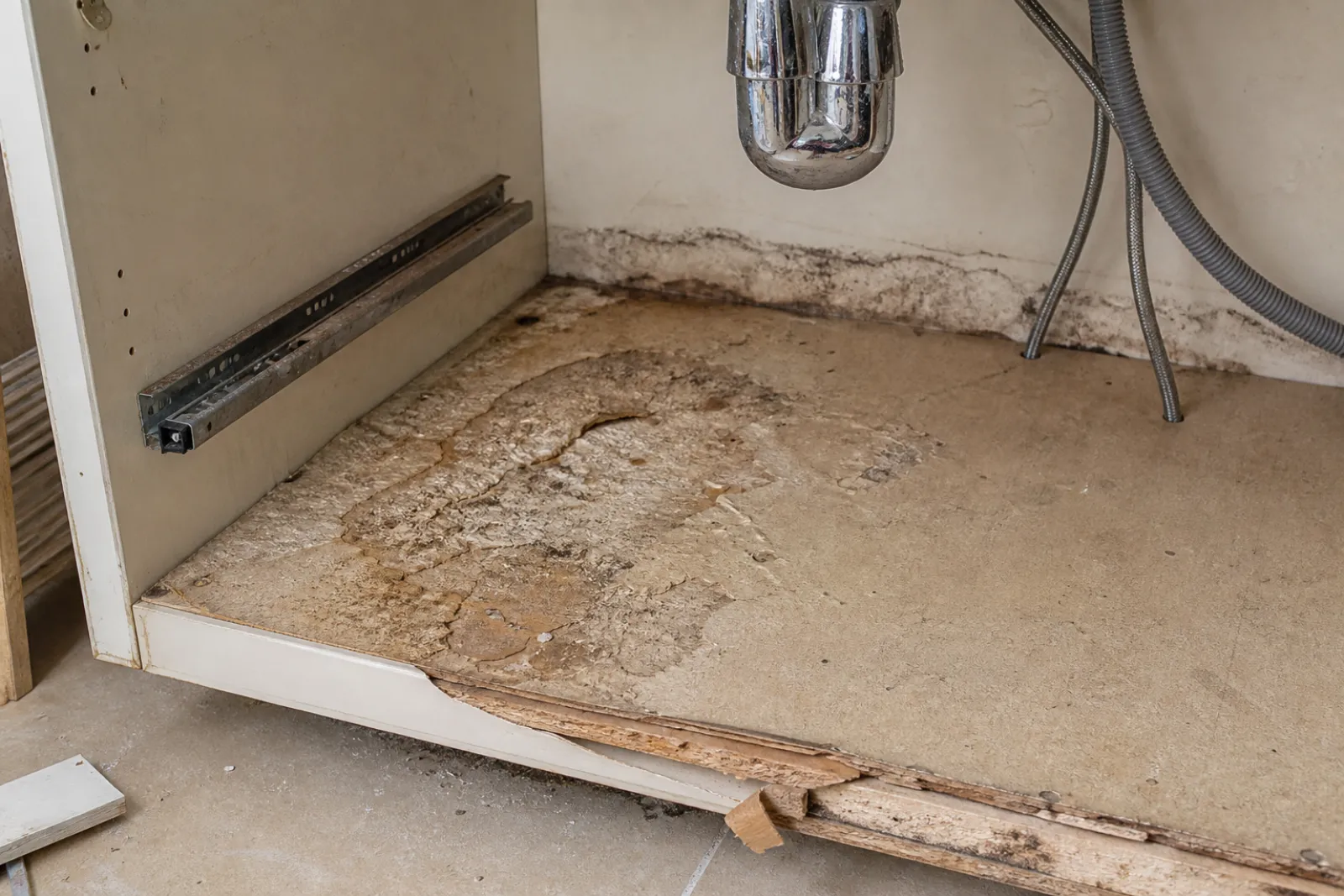
Imported flat-pack and modular systems compound this problem because they are manufactured to temperate-climate standards. The board grades, adhesives, and edge treatments used in systems designed for northern European or North American conditions are calibrated for environments that do not experience Dubai's thermal cycling or sustained coastal humidity. Regional climate compliance is a distinct specification requirement, and systems that perform reliably in cooler, drier markets routinely underperform once exposed to this environment. Homeowners typically discover the extent of the problem only after visible failure is well advanced.
This is precisely the territory our team at Halo Interiors works in every day. With an in-house joinery factory in Al Quoz and 30 years of delivering kitchen joinery in Dubai, we specify and manufacture for this climate from the outset rather than adapting products built for somewhere else. If you are planning a kitchen fit-out and want to understand what a correct specification looks like for your property, contact our team for a direct conversation.
Carcass Materials and How Humidity Changes the Equation
Solid timber is a poor carcass material in Dubai, and the reason is mechanical rather than aesthetic. Wood fibres absorb and release moisture as indoor humidity fluctuates, and in a Dubai apartment or villa the air-conditioning cycle creates precisely that instability: cool, dry air running for hours followed by periods when the system is off and ambient humidity rises sharply. Each cycle drives a small expansion or contraction in the timber. Over months, those micro-movements open glued joints, bow carcass panels, and cause door faces to warp out of plane. The problem is not visible immediately, which is why clients often attribute it to a manufacturing defect rather than a material selection error made at specification stage.
Engineered board eliminates most of that movement. Moisture-resistant MDF and moisture-resistant particleboard both use resin-bonded core structures that are far less responsive to humidity fluctuation than timber grain, making them dimensionally stable through the AC cycling that characterises Dubai interiors. The specification detail that matters here is using MR-grade board across the entire carcass run, not only beneath the sink. Kitchens in poorly ventilated layouts, or in apartments with coastal or north-facing exposures where wall condensation is more persistent, experience humidity infiltration along the full cabinet run. Limiting MR-grade board to the sink cabinet and using standard board elsewhere is a common shortcut that produces predictable failures within a few years. Our kitchen joinery services specify MR-grade as the baseline across every carcass panel, without exception.
Edge Banding: The Detail That Determines Long-Term Performance
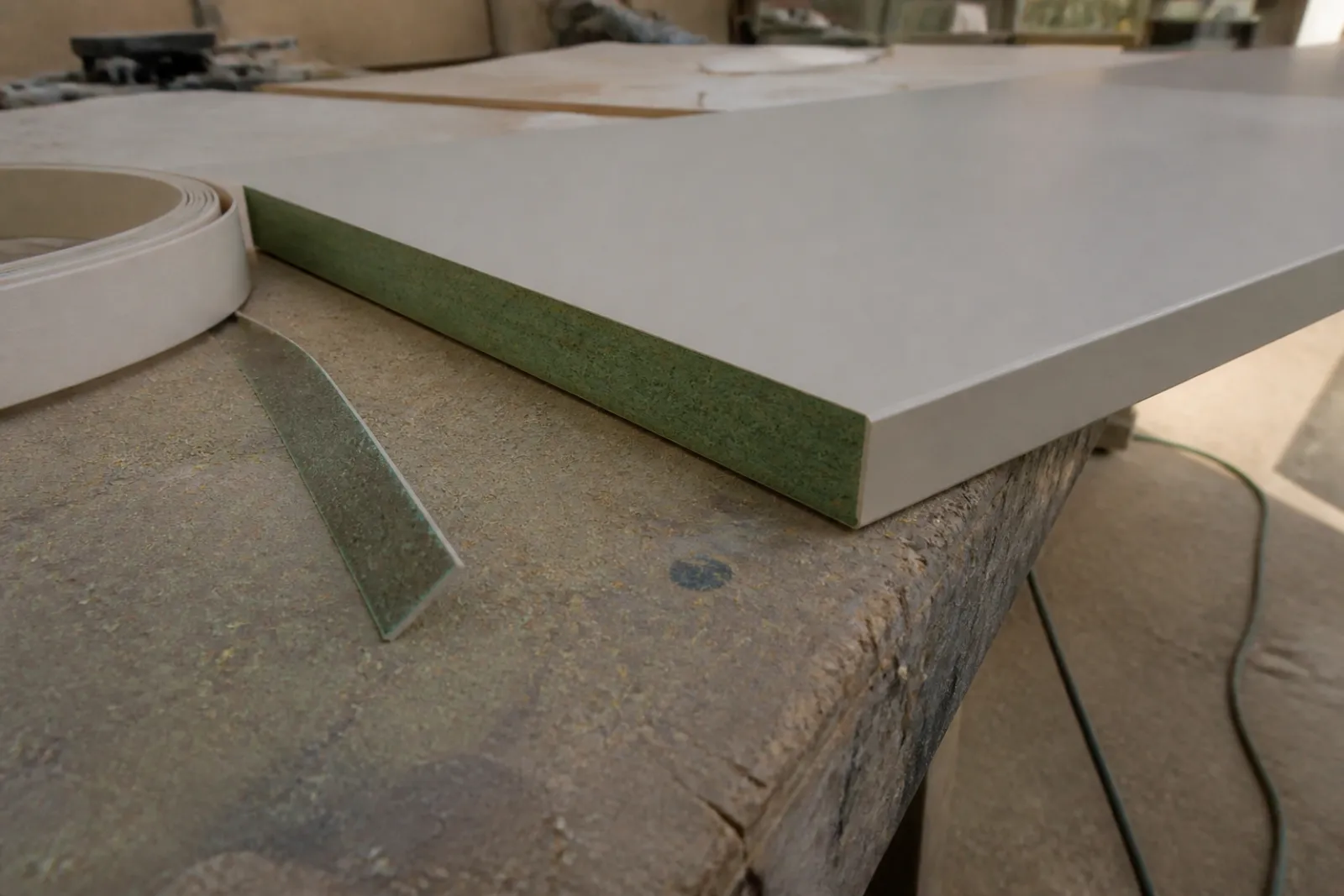
The exposed cut edge of any engineered board is its most vulnerable point. Raw or thinly banded edges absorb moisture by capillary action, pulling water directly into the board core where it causes the fibres to swell, delaminate, and eventually crumble. This is the most frequently underspecified detail in Dubai kitchen joinery, and understanding how material choices interact with moisture explains why edge banding quality has such an outsized effect on cabinet lifespan. Thick PVC or ABS edge banding, applied with a hot-melt bond that fully fuses to the substrate, is the minimum acceptable standard. Visible joins at corners, lifting at the ends, or thin tape applied without adequate pressure during bonding are warning signs that moisture ingress is only a matter of time.
Sealed Backs and Door Face Substrates
Sealed back panels are a related specification point that receives insufficient attention. Most kitchen cabinets are installed against walls that carry cold-water pipework or experience condensation on the masonry surface, particularly in older Dubai buildings where thermal bridging through external walls is more pronounced. An unsealed or single-skinned back panel placed against that wall acts as a moisture bridge directly into the carcass core. MR-grade back panels, fully sealed on all faces, interrupt that transfer path.
Door face material follows the same logic. Lacquered MDF door faces maintain paint adhesion reliably in humid conditions because the substrate does not move beneath the coating. Solid timber doors, by contrast, expand and contract with humidity, eventually cracking the lacquer surface and allowing further moisture ingress. Veneer doors are a middle option, but only when the substrate beneath the veneer leaf is a stable engineered board; veneer applied over solid timber or standard particleboard telegraphs the substrate movement as bubbling or edge peeling within a relatively short period in Dubai's climate.
The Hardware That Fails First — and Why It Matters
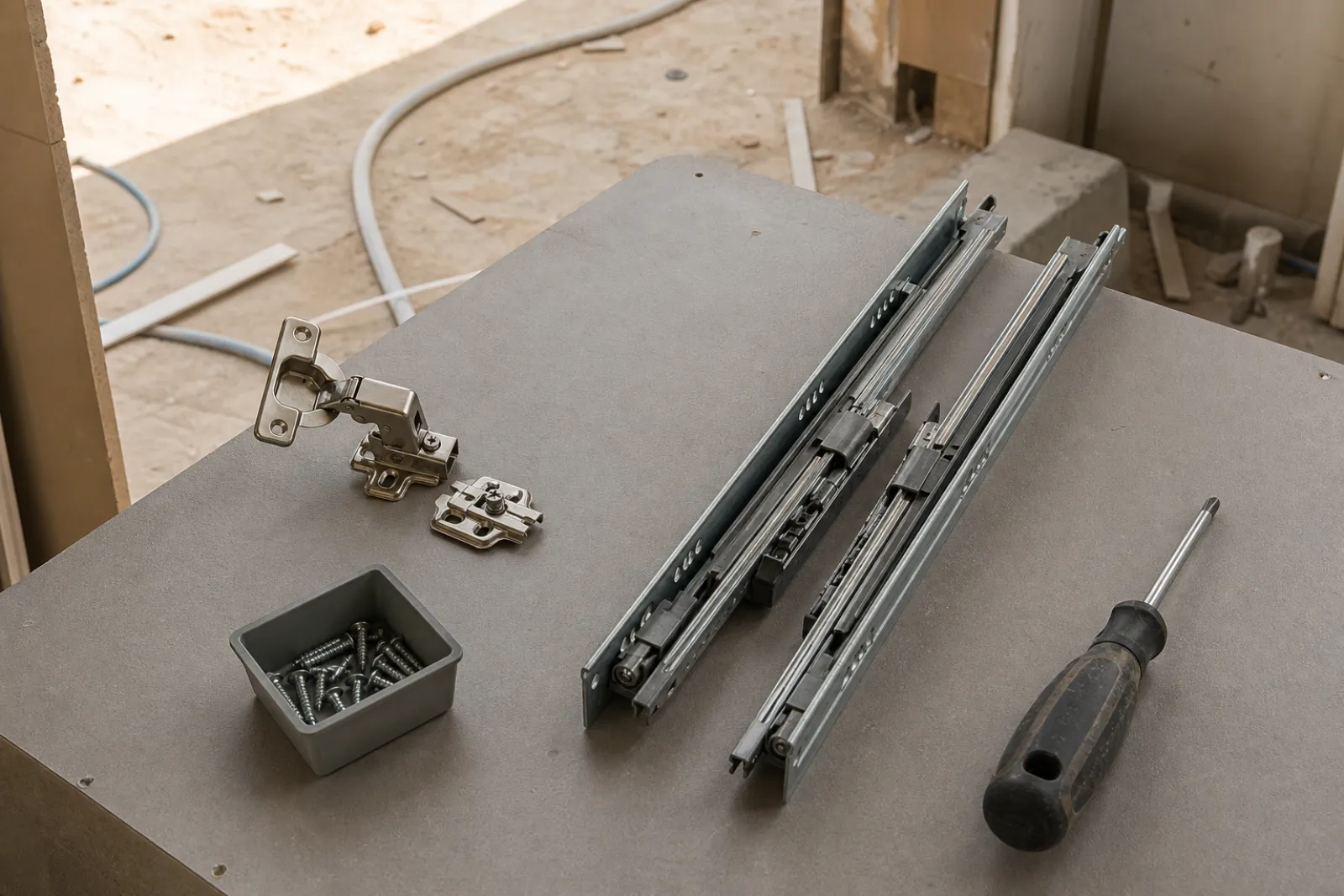
Hinges are where most Dubai kitchens begin to deteriorate, and the reason is straightforward. Low-grade zinc alloy hinges are porous at a microscopic level; when the kitchen cycles between cool, air-conditioned air and the humid conditions that accompany cooking or an open window, moisture enters the hinge body and begins attacking the internal mechanism. The geometry shifts gradually, doors drop, and no amount of adjustment recovers the original alignment. Full-overlay soft-close hinges with steel internals and an adjustable cam mechanism resist this process far longer because the core material is denser and the bearing surfaces are machined to tighter tolerances. This is not a marginal upgrade; it is the specification that determines whether cabinet doors still hang true after several years of use.
Drawer Runners in the Sink and Dishwasher Zone
The sink and dishwasher zone is the harshest microclimate in any kitchen. Steam, condensation, and splashback create sustained moisture exposure that pressed-steel side rails and unsealed ball-bearing races cannot tolerate indefinitely. The lacquer on standard side-mounted runners eventually breaks down under repeated thermal cycling, and once the base steel is exposed, corrosion follows quickly. Undermount runners with full-extension capacity and a sealed bearing carriage are the correct specification for these positions; the bearing assembly is enclosed rather than open to the cabinet interior, which removes the primary path for moisture ingress. Correct runner alignment during installation is equally important, as misalignment places uneven load on the bearing races and accelerates wear regardless of hardware quality.
Handleless Profiles and Where Push-to-Open Falls Short
Handleless kitchen design is now a standard specification at the higher end of the Dubai market, but the two main options carry very different maintenance profiles. Push-to-open mechanisms rely on a latch spring that compresses and releases with every use. In a high-frequency drawer exposed to kitchen heat, that spring degrades over time, producing inconsistent opening action and eventually requiring replacement. Aluminium J-pull profiles operate without any moving part; the profile is dimensionally stable, tolerates heat without deformation, and requires no servicing. For drawers that are opened dozens of times daily, the J-pull is the more reliable long-term choice, even if push-to-open delivers a cleaner visual result on lower-frequency doors such as tall larder units.
Integrated Appliances and Load-Rated Hardware
Integrated appliance cabinetry introduces a load-rating problem that is consistently under-specified. A fridge panel, oven housing door, or dishwasher front carrying a stone or solid-timber fascia adds considerable mass to the hinge or runner that supports it. When the hardware is specified for a standard cabinet door rather than the actual combined weight of the door and fascia, the mechanism operates beyond its designed capacity from day one. Sagging integrated doors within the first year of installation are almost always the result of this mismatch. Every weighted appliance door in our projects is specified against the actual door mass, not a generic assumption.
Stainless and Polymer Fittings in Moisture-Heavy Positions
Sink base units and hob cabinets require internal fittings rated for sustained moisture and heat exposure. Standard lacquered steel hinges and runners perform adequately in dry positions, but the lacquer layer is not a permanent barrier; once breached by steam or condensation, the underlying steel corrodes from within. Stainless steel or polymer-coated internal fittings remove this vulnerability. The material cost difference is modest; the labour cost of replacing corroded hardware inside a fitted kitchen is not.
Bespoke Joinery vs. Modular Cabinets: A Scope and Tolerance Question
Modular cabinet systems are built to fixed incremental widths, and Dubai properties are not. Walls are rarely truly plumb, soffits vary in depth across a run, and floor levels drift between zones. The result, when modular units meet these conditions, is an accumulation of visible compromises: filler strips packed against walls, dropped plinths shimmed to compensate for uneven floors, and scribed panels cut on-site to bridge the gaps that fixed dimensions could never anticipate. Individually, each adjustment appears minor. Across a full kitchen run, they read as exactly what they are: a standard product forced into a non-standard space.
The gap between an architect's drawing and the as-built condition of a completed property is a practical reality in Dubai, and it is wider than most buyers assume. Off-plan properties are particularly susceptible; developer drawings represent design intent, not finished construction, and dimensional variance between the two is common across both villa and apartment stock. Bespoke joinery addresses this directly by fabricating to the actual as-built dimensions captured during templating, not to a drawing that may not reflect what was built. That distinction determines whether cabinets sit flush and plumb or carry visible gaps at every wall junction and ceiling transition.
Integrated appliances are where the modular argument breaks down most completely. Appliance columns, concealed extractor housings, and island units with structural requirements, including seating overhangs and integrated sinks, require custom-engineered cabinetry that accounts for load paths, service access, and panel alignment. Modular components cannot accommodate these conditions without significant workaround joinery, and the cost of that workaround consistently erodes the apparent saving on the modular units themselves. The kitchen ends up costing more, and the finish still reflects the compromise.
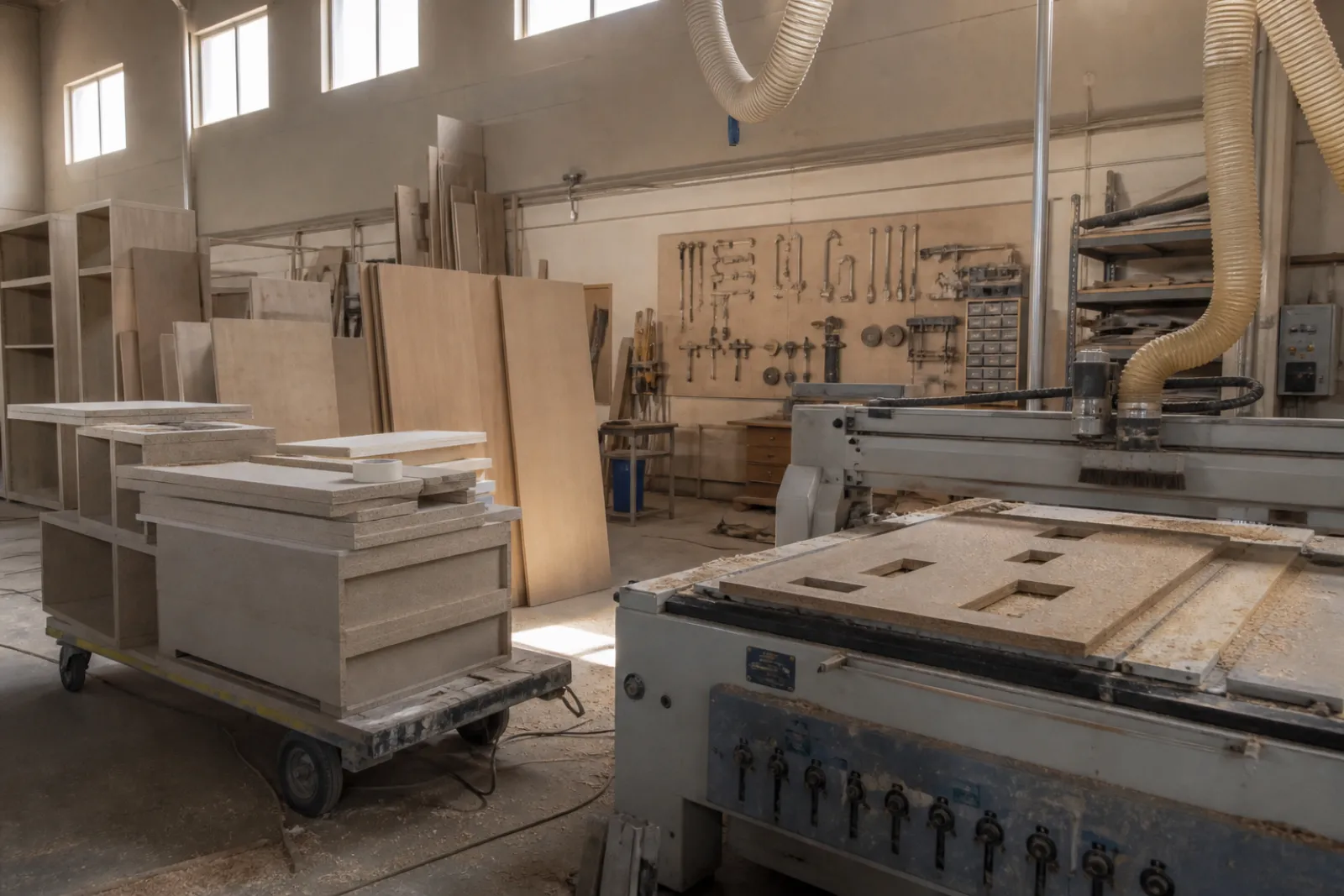
Our bespoke kitchen fit-outs are fabricated in our Al Quoz factory, where 75 skilled carpenters work to the millimetre tolerances established by a physical site template, not an assumed drawing dimension. Every cabinet in a run is cut to the verified dimensions of that specific space. Panel widths, column heights, and cornice details are resolved before a single board is processed, which means the installation proceeds without on-site improvisation and without the filler strips that signal a product that did not quite fit. For kitchens where the brief extends beyond cabinetry into customised furniture such as island seating, breakfast bars, or integrated shelving, that same fabrication discipline carries through every element of the scope.
Worktop Options and How They Pair With Cabinetry
Quartz composite is the worktop material we specify most consistently across our kitchen and wardrobe projects in Dubai, and the reasons are practical rather than fashionable. Its non-porous surface resists staining from oils, acids, and moisture without requiring periodic sealing. The engineered consistency of its colour and pattern means that when we match it to handleless lacquered cabinetry or a natural veneer finish, the tonal relationship holds across the full run, with no slab-to-slab variation to manage.
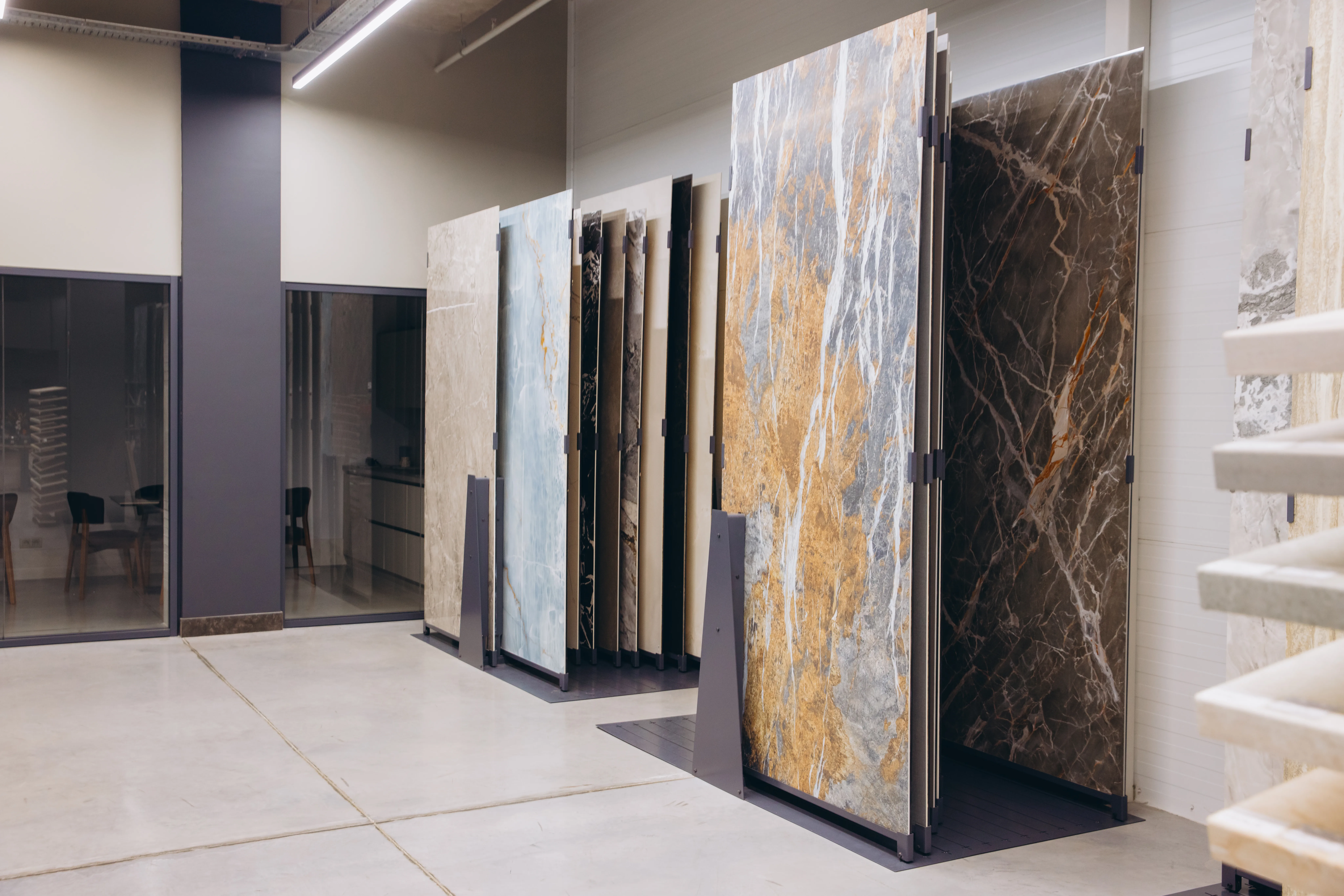
Sintered stone is increasingly specified in handleless and minimalist kitchen designs, where its thinner profile suits the clean horizontal lines of the cabinetry. The material performs well, but the real variable is fabrication capability. Sintered stone is significantly harder to cut than quartz or granite; it requires precision CNC templating and the right machinery to avoid cracking during cutting. Specifying it without confirming that your fabricator can work it accurately is a sequencing risk, not just a materials choice. Our in-house joinery facility handles this templating process directly, templating from as-built conditions rather than from drawings.
Natural marble and granite are appropriate in neoclassical and ultra-luxury Dubai interiors, where their aesthetic weight is consistent with the overall design register. Both are porous and require regular sealing in a kitchen environment, where cooking oils and acidic liquids are the primary threat. When pairing polished stone with high-gloss lacquered cabinetry, colour-temperature alignment is critical. A cool-toned stone against a warm-toned gloss finish creates visual dissonance across a reflective surface, and this is a detail that matters in a large open-plan kitchen where both surfaces read simultaneously.
Solid timber worktops carry the same dimensional instability as solid timber carcasses in Dubai's climate. The moisture movement that causes carcass joints to open will do the same to a timber worktop surface, particularly around the sink zone. Where a client wants the warmth of a wood tone on the worktop, we specify engineered timber composite surfaces with stabilised cores. These hold their dimensions under the humidity cycling between air-conditioned interiors and ambient conditions, and they can be finished and maintained in the same way as solid timber without the structural risk.
Templating, Acclimatisation, and Installation Sequencing
Every kitchen we fabricate begins with a physical site template taken after all wet trades are complete. Tiling, plastering, and screeding each introduce small dimensional deviations; across a three-metre kitchen run those deviations compound, and a cabinet fabricated to drawing dimensions will arrive on site with gaps, overhangs, or alignment conflicts that no amount of scribing can fully correct. The template is not a preliminary step; it is the fabrication brief.
Acclimatisation Before Fitting
Our joinery factory in Al Quoz operates in a controlled environment. A construction site, particularly one where HVAC has only recently been commissioned, operates at a different temperature and humidity profile. Engineered boards carried from one environment into the other will absorb or release moisture and move slightly before reaching equilibrium. Fitting carcasses before that stabilisation occurs locks stress into joints, glue lines, and hinge mounting points; the result appears weeks later as door twist, drawer bind, or joint separation. We store fabricated carcasses and doors in the installation environment for a set period before any fixing begins, allowing the material to reach equilibrium with the space it will occupy permanently.
Installation Sequence as a Dependency Chain
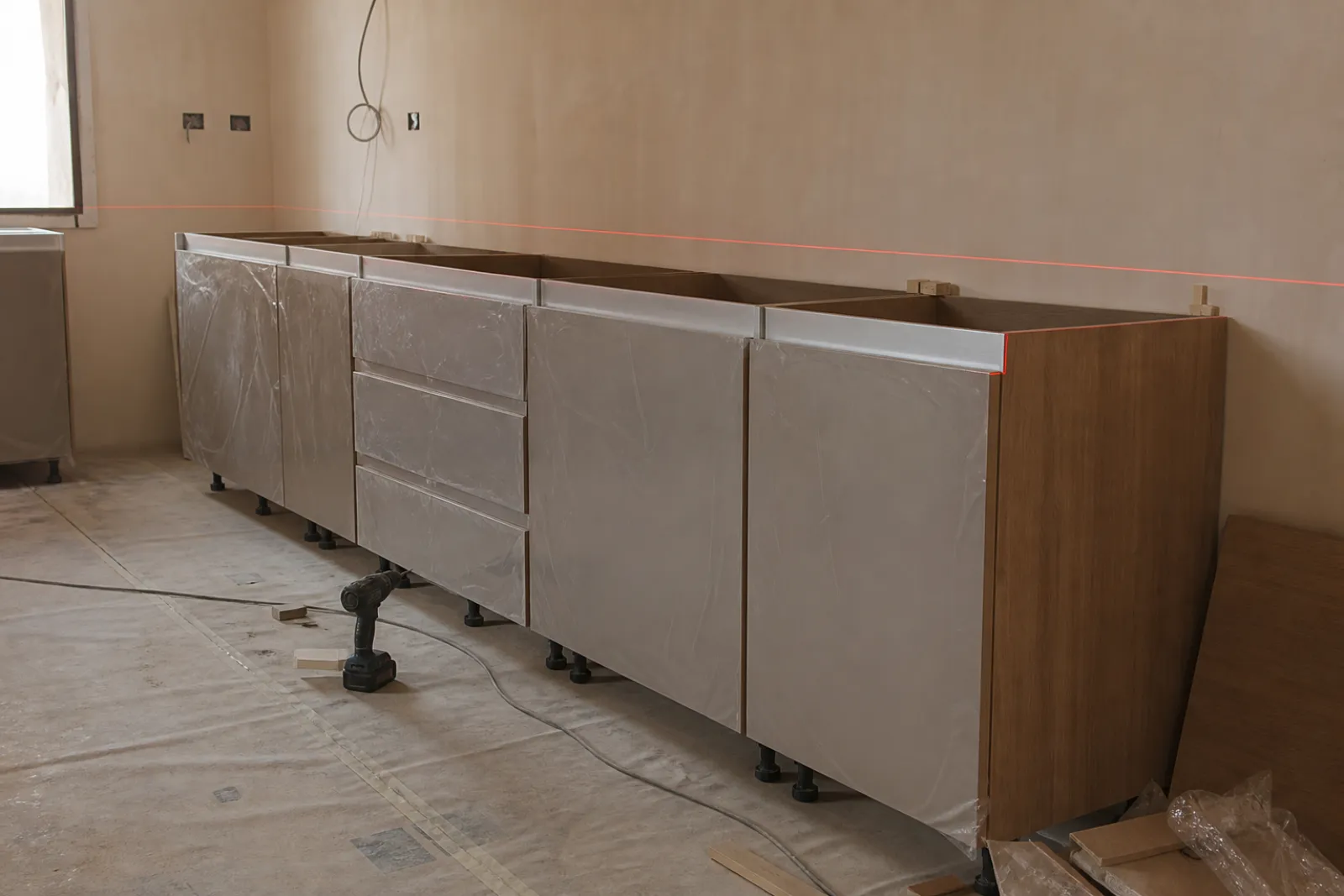
Base cabinets are set and levelled first, because every subsequent dimension flows from that datum. Worktop templating follows once the base line is confirmed; wall units and tall columns are hung after the worktop height is fixed, not before. Appliance integration is the final fixed element. Cutting appliance apertures or confirming service connections before the worktop is templated introduces dimensions that may still change.
MEP coordination sits inside this sequence, not alongside it. Our in-house MEP team confirms socket positions, drain stub-outs, and gas connection points before any carcass is fixed to the wall. Retrospective chasing through finished tile or plastered walls to reposition a socket that conflicts with a cabinet carcass is among the most avoidable cost items in a kitchen fit-out, and it is entirely a sequencing failure. A kitchen installed out of order, whether cabinets fixed before tiling is complete or worktops templated before bases are levelled, will require remedial work. That remedial work invariably costs more than the time that was notionally saved by compressing the sequence.
Fabrication and Installation Timelines
The table below reflects our standard programme, drawn from delivery across 1,200+ completed projects.
| Phase | Weeks | Activity |
|---|---|---|
| Design and templating | 1–2 | As-built site measurement, 3D layout, finish and hardware selection |
| Material procurement and factory production | 3–6 | Material sourcing, CNC cutting, carcass assembly, door and finish application |
| Quality check and acclimatisation | 7 | Factory QC inspection; completed units acclimatise to ambient conditions |
| Installation and hardware setting | 8–9 | On-site fixing, levelling, door and drawer fitting, hardware calibration |
| Appliance integration and snag | 10 | Built-in appliance commissioning, reveal gap checks, snagging sign-off |
Bespoke kitchens in larger villas, or those incorporating complex integrated appliance columns with combination ovens, warming drawers, and tall fridge-freezer stacks, require additional production time beyond the standard Weeks 3 to 6 band. Our team confirms the full programme at design sign-off, not mid-fabrication; revising scope once cutting has begun is the single most reliable way to extend a timeline and introduce sequencing errors.
For renovation projects where wet trades are still active, we do not release cabinetry to production until we hold a confirmed practical completion date from the main contractor. Fabricating against an unconfirmed site date means finished goods must be stored, and storage conditions in Dubai, particularly in summer, can reverse the acclimatisation benefit delivered in Week 7. That step exists precisely because the differential between a factory environment and a live site can cause board-based substrates to shift; undermining it defeats the purpose.
Our completed projects portfolio demonstrates delivery across villa renovations, apartment fit-outs, and developer handover programmes at varying scales and specification levels.
For developer handovers with confirmed site access, express programmes are available. Timeline compression is achieved through parallel production scheduling, running multiple fabrication batches concurrently across our Al Quoz joinery facility. Acclimatisation and site template verification remain non-negotiable process gates regardless of programme type; those steps are not where time is recovered.
Work With Halo on Your Kitchen Cabinets
Halo Interiors LLC has been fabricating and installing bespoke kitchen cabinets in Dubai since 1996. That is 30 years of on-site experience in this specific climate, across this specific building stock, with a 4.9 Google rating and DM Approved status that matters at handover and for any subsequent mortgage or title process on your property.
Our Al Quoz joinery facility covers 15,000 sq ft and is staffed by 75 skilled carpenters and painters, including third-generation craftsmen who have spent their careers working on Dubai residential and commercial projects. Every cabinet carcass, door, and drawer front is fabricated against the as-built template of your specific space. Nothing leaves the factory to a generic dimension.
What distinguishes our delivery model is that every element of the scope sits under one roof. Design, templating, fabrication, MEP coordination, appliance integration, installation, and handover are all managed by our team. There is no gap between contractor A finishing and contractor B arriving; no dimension lost in translation; no disputed responsibility when something does not align. The project completes as a single, coordinated output.
Frequently Asked Questions
What cabinet carcass material holds up best in Dubai's humidity?
Moisture-resistant engineered board, either moisture-resistant MDF or moisture-resistant particleboard, outperforms solid timber in Dubai's climate because it does not expand and contract with humidity cycling. Solid timber absorbs and releases moisture as conditions change, which leads to warping, joint failure, and door misalignment over time. However, the board specification alone is not sufficient. Sealed backs and fully bonded edge banding are equally critical; unsealed board edges are the primary entry point for moisture ingress, regardless of the substrate grade. Our bespoke joinery team treats all four edges and specifies sealed cabinet backs as standard on every kitchen we produce.
How long does a bespoke kitchen cabinet project take from order to handover?
Based on our delivery experience, a bespoke kitchen from design sign-off to handover typically takes eight to ten weeks. That window covers site templating after wet trades are complete, factory production in our Al Quoz facility, board acclimatisation on site, installation, and appliance integration. Projects involving complex integrated columns, structural island requirements, or developer-programme constraints may require a longer production window, which our team confirms at sign-off rather than mid-programme. Rushing any of these stages, particularly acclimatisation and templating, is where timeline pressure most often translates into fitment problems on site.
What worktop materials work best with lacquered or veneer cabinetry in Dubai?
Quartz composite pairs well with both lacquered and veneer cabinetry. It is non-porous, consistent in colour across a full slab, and tolerant of normal cooking heat. Sintered stone suits handleless and minimalist lacquered kitchens specifically, because its thinner available profile reinforces the clean horizontal lines that define that aesthetic. Natural stone works with both finish types but requires regular sealing and careful colour-temperature matching against the cabinet tone; a warm-grain veneer and a cool-grey marble can read as mismatched if the pairing is not resolved at the design stage. Our kitchen cabinet specialists work through worktop and cabinet finish combinations during the design phase, not as an afterthought during procurement.
Why do cabinet hinges and drawer runners fail in Dubai apartments?
Low-grade hinges and runners corrode internally when humidity cycles through them repeatedly, particularly in sink and dishwasher zones where ambient moisture is consistently higher than the rest of the kitchen. The failure mechanism is internal; the outer casing can look intact while the bearing carriage or spring tension has degraded. The correct specification is steel-internal soft-close hinges and undermount runners with sealed bearing carriages in all wet-proximity positions. Hardware must also be rated to the actual door or drawer load it will carry; an oversized door on an undersized hinge will accelerate wear regardless of the hinge's material quality. This is a specification decision made at the design stage, not a product that can be substituted during installation without re-engineering the door-to-carcass geometry.
What is the difference between bespoke and modular kitchen cabinets in Dubai?
Modular cabinets are manufactured in fixed width increments and Dubai's as-built construction rarely conforms to those increments. Walls are seldom truly plumb, soffits vary in depth across a run, and floor levels drift between zones. The result, when modular units are installed into an as-built space, is visible filler strips, gap compromises at column junctions, and worktop overhangs that do not align with the design intent. Bespoke joinery is fabricated to the actual dimensions of your space, measured after wet trades are complete, which delivers flush integration, full use of available volume, and structural compatibility with integrated appliances and island requirements. For a detailed look at how we approach customised furniture and cabinetry in Dubai, including scope, materials, and finish options, our services section covers the full programme.